
JAPANESE GARDENS
Design, Symbolism & Spiritual Beauty
Discover the philosophy, key features and plants behind one of the world's most meditative garden styles — and how to bring Japanese garden design to your own outdoor space in the UK.
Japanese gardens are among the most serene and intentional spaces ever created. Where western gardens have traditionally sought to tame and shape nature to our will, Japanese garden design does the opposite — it works with nature, drawing inspiration from the landscape and blending seamlessly into it. The result is a space that feels sacred, timeless and deeply alive.
Whether you are planning a Japanese-inspired garden in the UK, visiting a traditional Japanese garden for the first time, or simply curious about the philosophy behind these extraordinary spaces, this guide covers everything you need to know — from the symbolism of stones and raked gravel to the best Japanese garden plants for a British climate.
The Philosophy Behind Japanese Garden Design
At the heart of every Japanese garden is a spiritual and philosophical intent that sets it apart from anything in the western tradition.
Western gardens — particularly English gardens — have historically been designed around order, symmetry and balance. We like to dominate our surroundings, shaping nature into what we consider to be the ideal. Japanese gardens take the opposite view: they are asymmetrical, restrained and deeply in tune with the natural world. Irregularities are not corrected but celebrated, because they mirror the subtle, imperfect balance found in nature itself.
Where English gardens are filled with joyful colour and striking borders, Japanese garden design favours a restrained palette — focusing instead on form, texture, foliage shape and stone. Natural materials like moss, rocks, gravel and water do the heavy lifting.
The ethos of Japanese gardens has its roots in Shintoism and was further shaped by Chinese Buddhist monks who brought with them the concepts of Yin and Yang and the four elements: air, earth, fire and water. Both Chinese and Japanese garden traditions have a strong association with the spirit world and with the connection between humanity and nature — a connection that the western world is only beginning to rediscover.
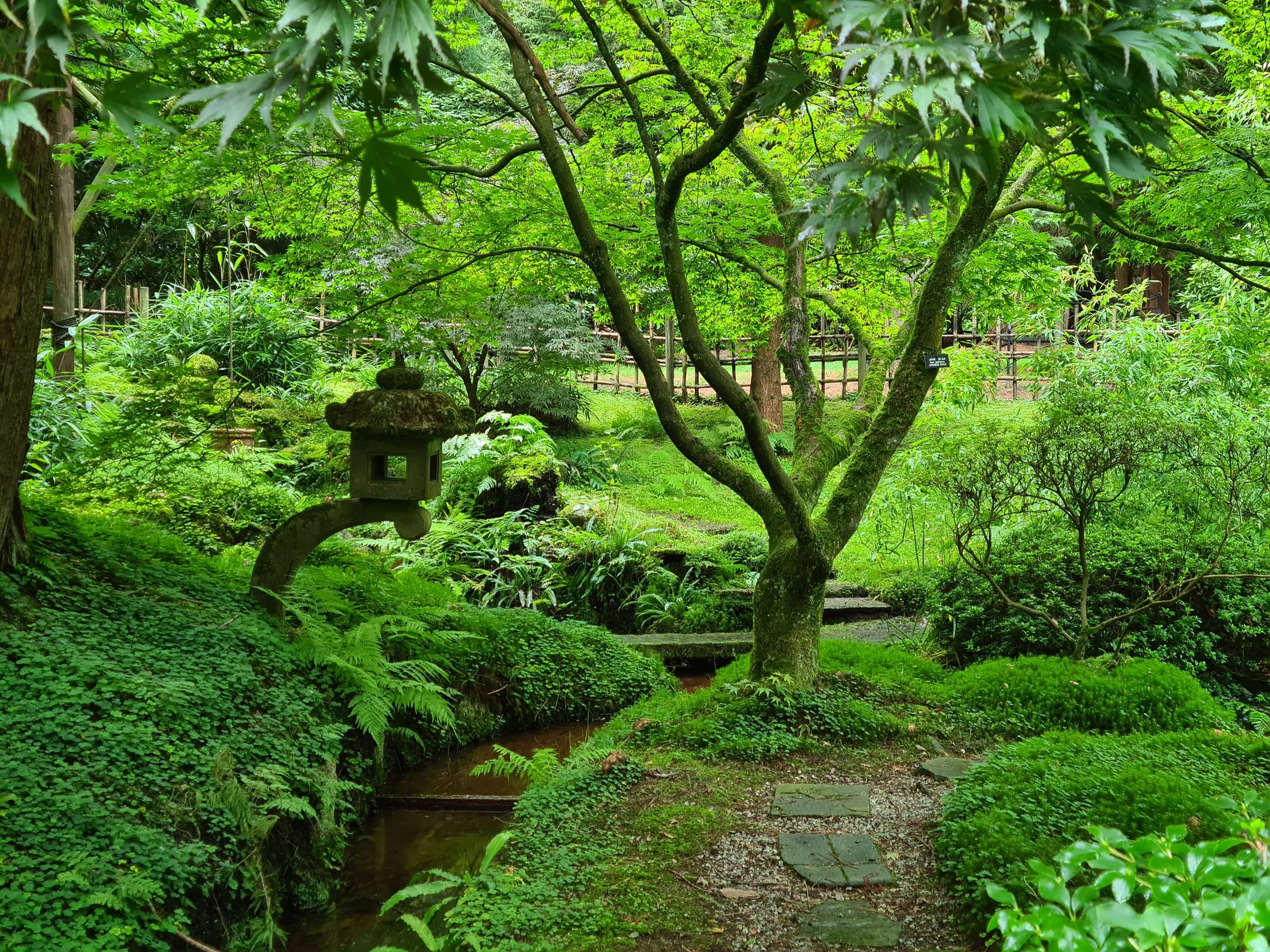
Photo Credit: Manoj Malde
The Japanese Garden at Tatton Park. This garden atmosphere in this garden is something that can be described as sacred. There is a peace and tranquility in this garden that transports you to a heavenly place.
Wabi-Sabi: Finding Beauty in Imperfection
One of the most important concepts in Japanese culture — and in Japanese garden design — is wabi-sabi: the appreciation of perfection found within imperfection.
Wabi refers to rustic simplicity, freshness and quietness. It is the feeling of peace found in natural, unpretentious objects.
Sabi refers to the beauty that comes with age, wear and the natural passage of time. It celebrates things that are weathered, flawed or marked by the seasons.
Together, wabi-sabi is the philosophical foundation upon which Japanese garden aesthetics rest. It is why a moss-covered stone or a gnarled pine tree is considered more beautiful than anything perfectly manicured. It is why Japanese gardens feel ancient even when they are newly made.
Key Features of a Japanese Garden — and What They Mean
Nothing in a Japanese garden happens by accident. Every element — from the placement of a single stone to the direction in which gravel is raked — carries meaning.
The Torii Gate
Some Japanese gardens feature a torii gate, often painted a striking vermilion red. Positioned at the entrance to a Shinto shrine, the torii marks the transition from ordinary ground into sacred space. It signals to the visitor that they are crossing a threshold — leaving the everyday world behind.
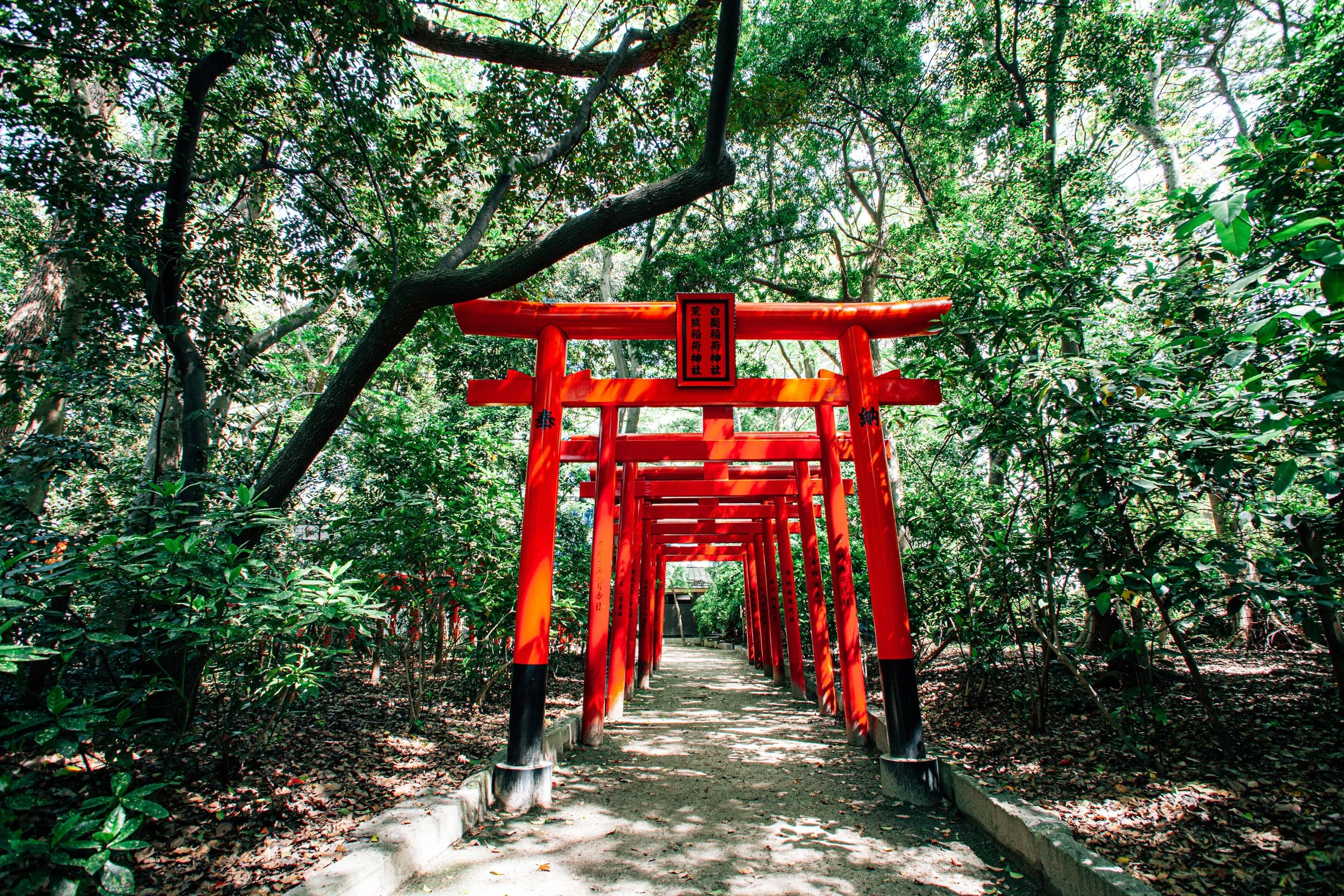
Here, the torii gate has been transformed into an avenue, rather like timber arches in English gardens, used across walkways to grow climbers on.
Rocks, Boulders and Stones
Japanese gardens are rich in rock symbolism. The size, formation and even the angle at which a rock is placed all carry significance:
Tall, upright stone — represents the crane, a symbol of longevity
Low, flat stone emerging from water — represents the turtle, also a symbol of longevity
Large rock, half-buried in earth — represents stability and security
Group of three rocks — the Buddhist trinity
Rocks of varying heights grouped together — a mountain range
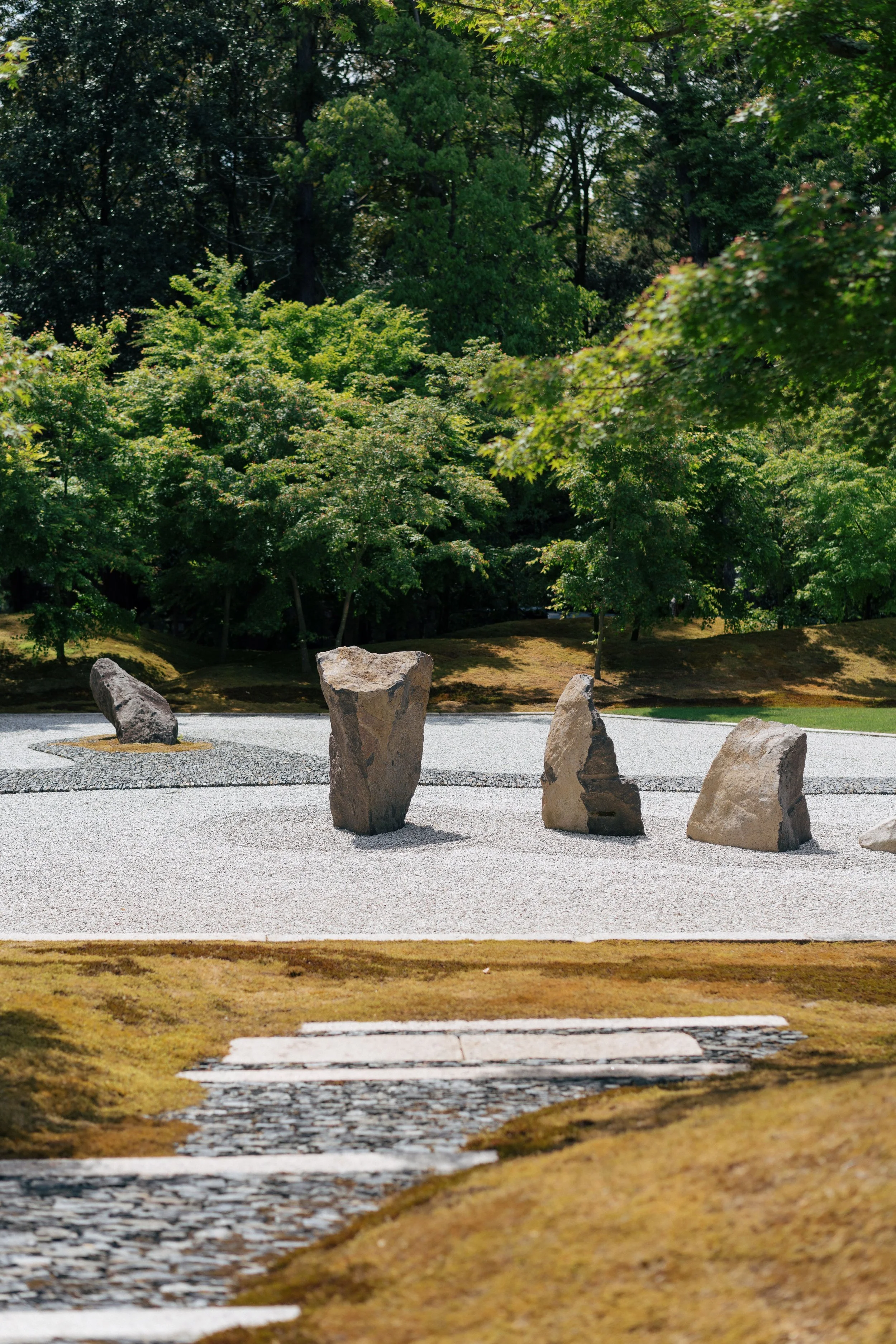
Natural rocks and boulder are used throughout Japanese gardens. Their size and how and where they are placed will signify what they represent
In a karesansui (dry rock garden), large rocks represent islands or mountains, while the surrounding raked gravel represents the sea.
Raked Gravel and Dry Landscapes
The raked gravel gardens of Japan — karesansui — are among the most recognisable images in Japanese garden design. But their beauty is inseparable from their symbolism.
Gravel in a Japanese garden primarily represents water: oceans, rivers, waves and ripples. The patterns raked into the gravel carry their own meanings:
Straight lines — calm, still water
Curved or circular raking — waves or ripples
Concentric circles — the rings made when a raindrop or stone touches water
Whorls and spirals — whirlpools or the dynamic flow of water
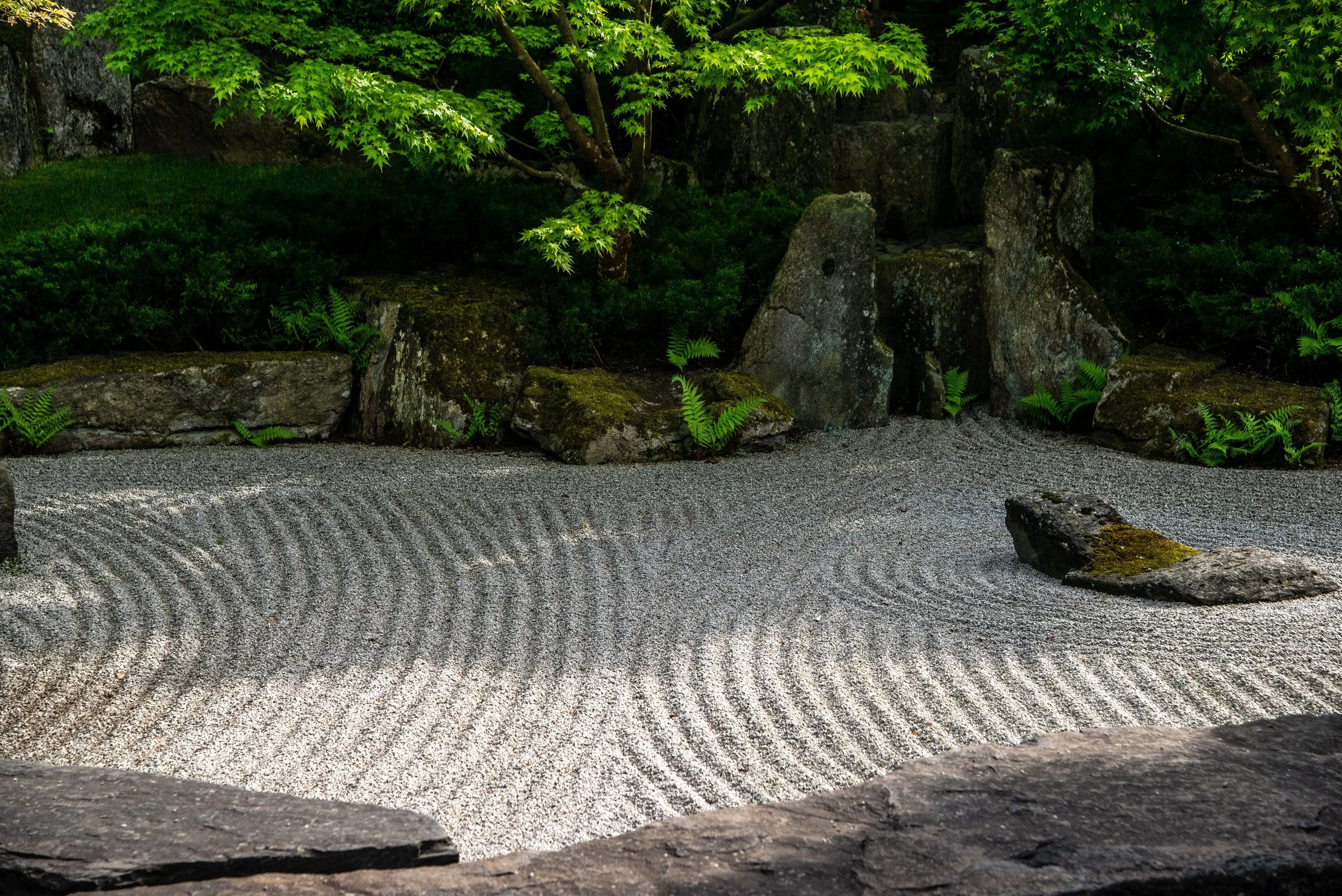
Raked gravel in Japanese gardens is a representation of water. The patterns and the way the gravel has been raked will signify whether it is an ocean, river, wave or ripple.
Pathways and Their Purpose
Japanese garden paths are never merely functional — they are deeply intentional.
A tobi-ishi path, made from large, informally laid flat stones, forces the visitor to slow down and place each foot with care. This is not accidental — the path is preparing the visitor, mentally and spiritually, for the tea ceremony ahead.
Plank timber paths are often laid in a zig-zag pattern above water. As well as slowing the visitor down and offering different views at each turn, these paths serve a more mystical purpose: the Japanese believe that evil spirits travel in straight lines, so a zig-zag path offers protection.
A meandering path leading up to a teahouse represents the road to enlightenment — a reminder that, in old age, we leave the world behind in search of something more enduring.
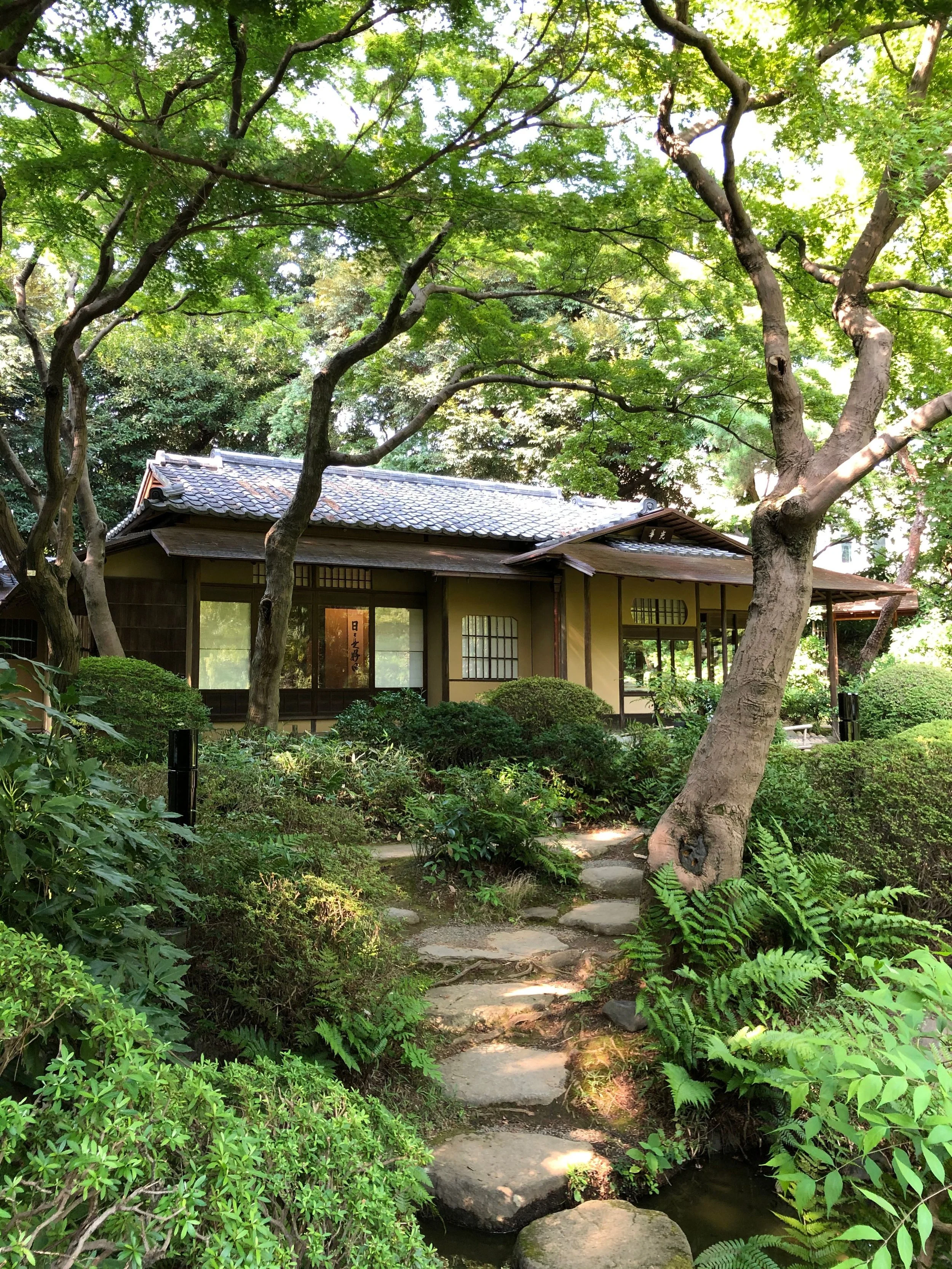
Paddle stone paths known as tobi-ishi are synonymous with Japanese gardens. When walking along these paths you have to slow down and concentrate. This really engages you with your surroundings and nature.
The Stone Lantern (Ishi Toro)
Stone lanterns (ishi toro) were originally used to line the paths of Shinto shrines. From the sixteenth century onwards, tea masters began incorporating them into garden design, and they remain one of the most iconic features of traditional Japanese gardens.
Every ishi toro, regardless of its design, reflects Buddhist cosmology through five elements:
PART OF LANTERN ELEMENT MEANING
Base/Foot Earth Stability & grounding
Mid-section Water The foundation beneath fire
Fire-box Fire Intent, will & desire
Cap Wind Growth, expansion & human mind
Bud finial Heaven Pure energy, compassion & wisdom
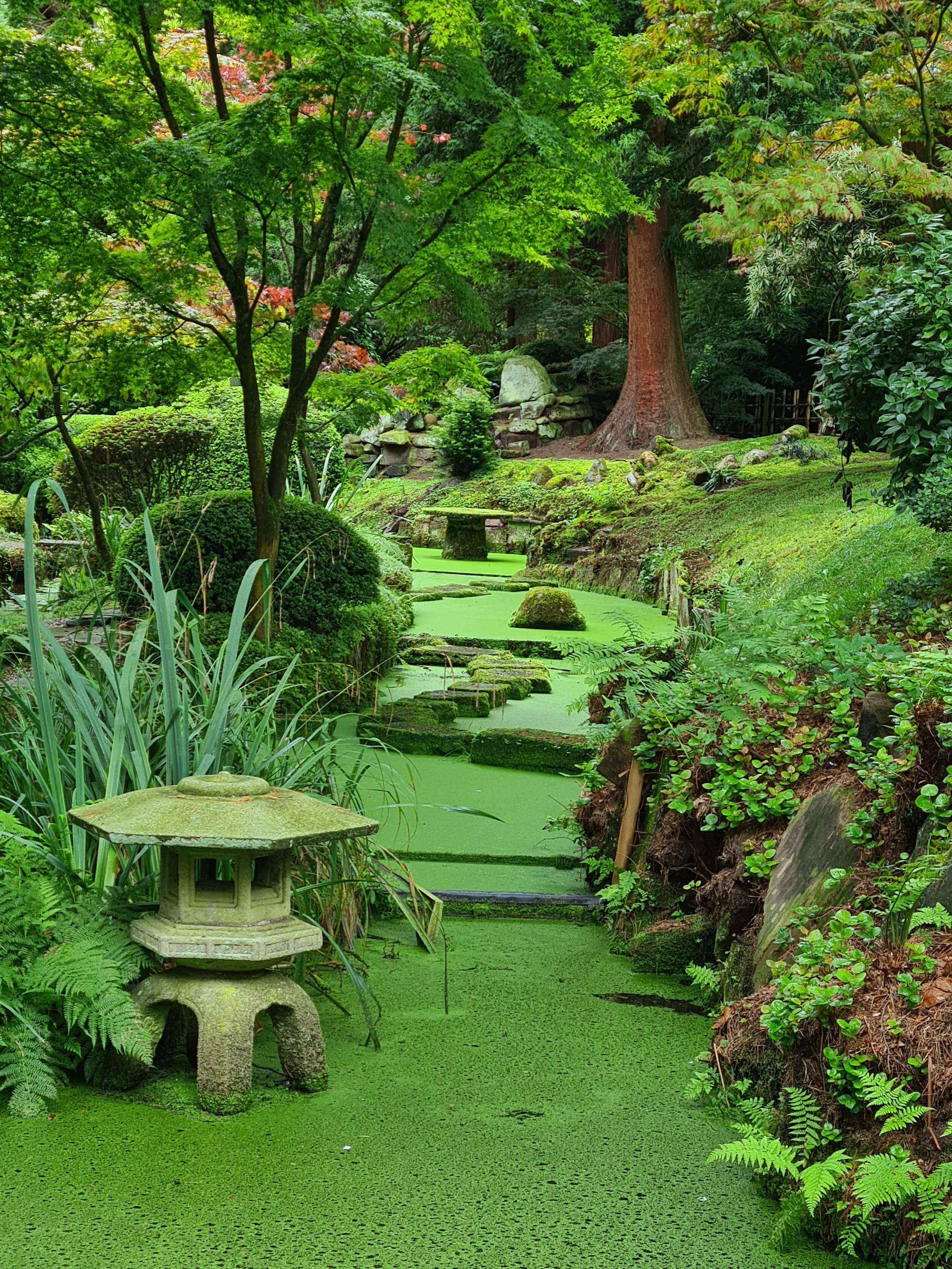
Photo Credit: Manoj Malde
An iconic feature of a Japanese garden is the ishi toro. They come in various sizes. They are sculptural and make a great focal point without being load and overbearing.
Japanese Garden Plants for the UK
Creating a Japanese-inspired garden in the UK is entirely achievable with the right plant selection. The following plants are well suited to the British climate and capture the essential qualities of Japanese garden aesthetics: restrained colour, beautiful form, seasonal change and year-round texture.
Trees
Acers (Japanese Maples) are the signature tree of any Japanese garden. Valued for their intricately lobed leaves, graceful branch structure and spectacular autumn colour — ranging from deep crimson through to gold and coral — they are the natural starting point for any Japanese planting scheme.
Acer palmatum (Japanese Maple)
Acer Sango-Kaku (Coral Bark Japanese Maple)
Japanese Cherry Blossom (Sakura) represents rebirth and the fleeting transition of the seasons. The brief window when the blossom is in bloom is one of the most celebrated moments in the Japanese calendar.
Prunus serrula Tibetica (Tibetan Cherry)
Prunus Kanzan (Kanzan Cherry)
Pines are cloud-pruned or shaped to resemble wind-sculpted trees, and symbolise longevity, hardiness and perseverance — essential qualities in Japanese culture.
Pinus thunbergii (Japanese Black Pine)
Pinus sylvestris Watereri (Dwarf Scots Pine)
Taxus baccata (Yew)
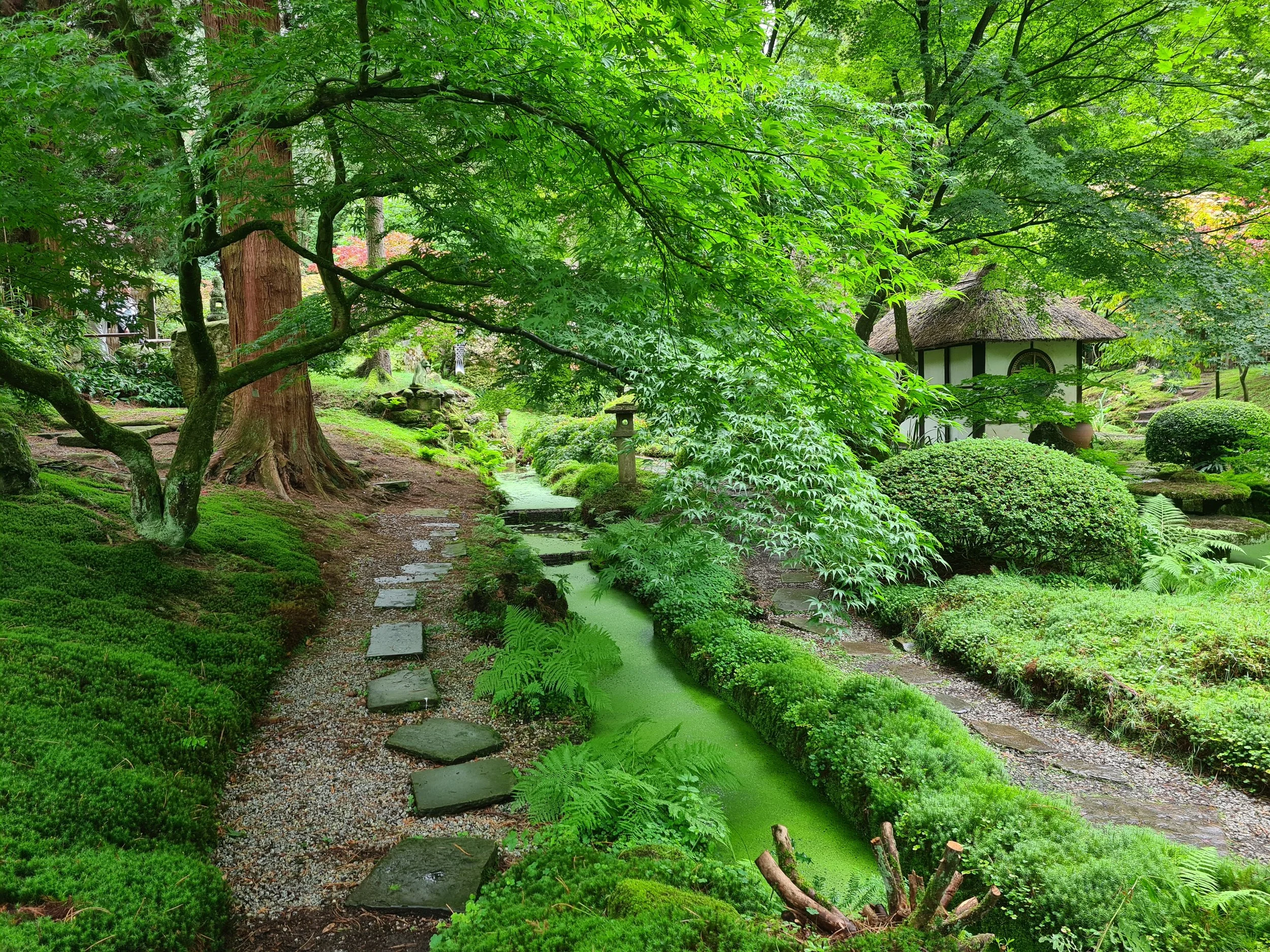
Photo Credit: Manoj Malde
Signature trees in Japanese gardens are Acers with their delicately cut leaves and elegant branch structure. Acers provide the most beautiful autumn colours.
Shrubs
Camellias bring glossy, evergreen foliage and late winter to early spring flowers in shades of pink, red and white — one of the few moments of exuberant colour in a Japanese planting scheme.
Camellia japonica Nuccio's Cameo
Camellia Black Lace
Azaleas and Rhododendrons produce clouds of bloom in pinks, purples, whites and reds, and have long been a favourite in both Japanese and western gardens.
Bamboo carries deep cultural resonance in both Chinese and Japanese garden traditions, symbolising perseverance, tolerance and fortitude. Important note: always install a root barrier before planting bamboo, as it spreads vigorously.
Phyllostachys nigra (Black Cane Bamboo)
Fargesia rufa (Chinese Fountain Bamboo)
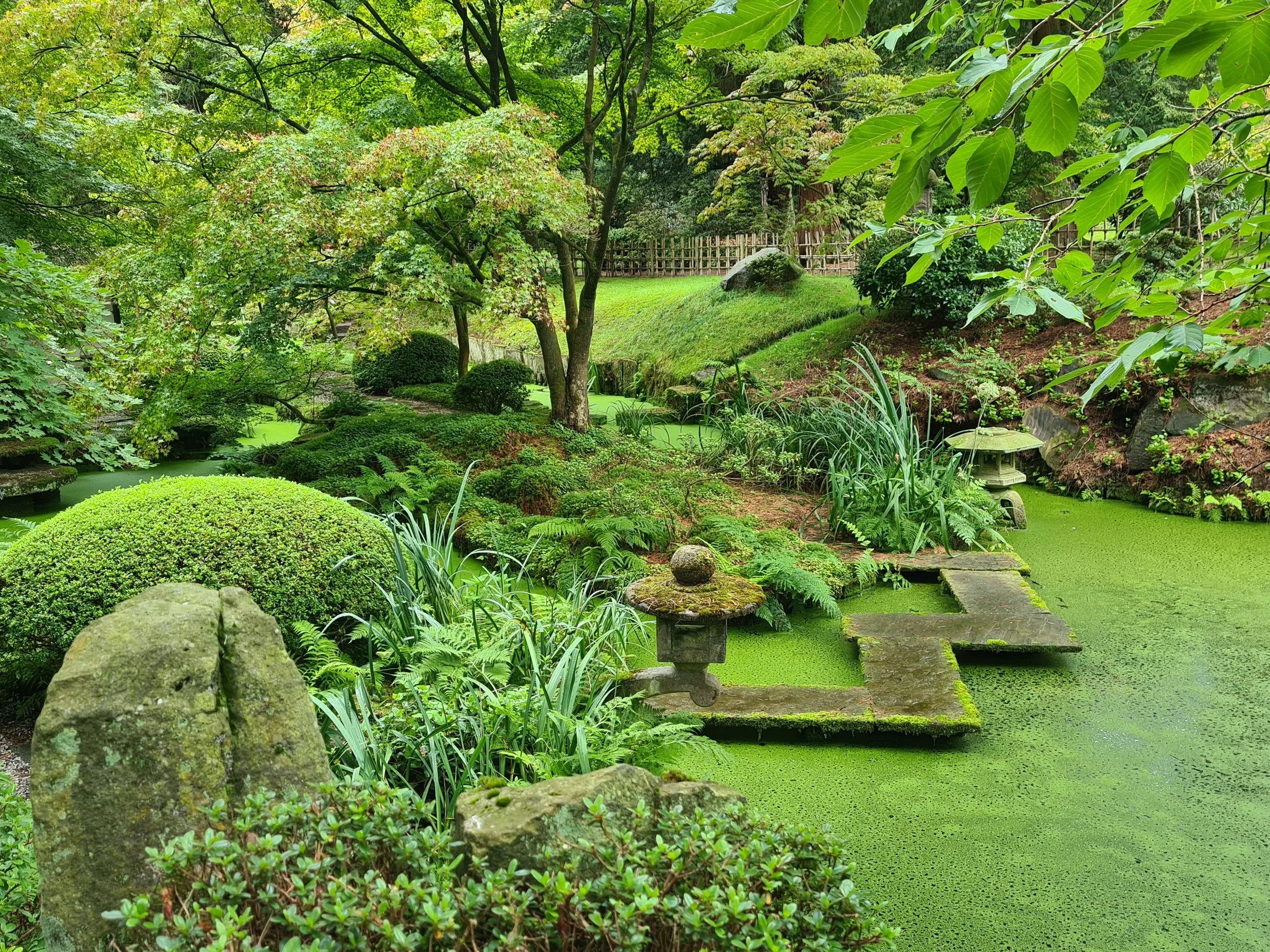
Photo Credit: Manoj Malde
This zig-zag stone pathway is set over water. The Japanese have mystical reason for using zig-zag paths. They believe travelling along a zig-zag path protects you from evil spirits who can only travel in straight lines.
Foliage and Ground Cover
Hakonechloa macra (Japanese Forest Grass)
Athyrium niponicum var. pictum (Japanese Painted Fern)
Dryopteris erythrosora (Japanese Wood Fern)
Pachysandra terminalis (Japanese Spurge)
Hosta Devon Green
Hosta Blue Mouse Ears
Asarum europaeum (Wild Ginger)
Moss — perhaps the most essential material in any Japanese garden
Leptinella squalida (Brass Buttons)
Flowers
Iris ensata (Japanese Iris)
Wisteria floribunda
Anemone × Hybrida Honorine Jobert
Lotus — deeply significant in Buddhism, symbolising purity
Chrysanthemum — the symbol of the Japanese Imperial family, and an emblem of autumn
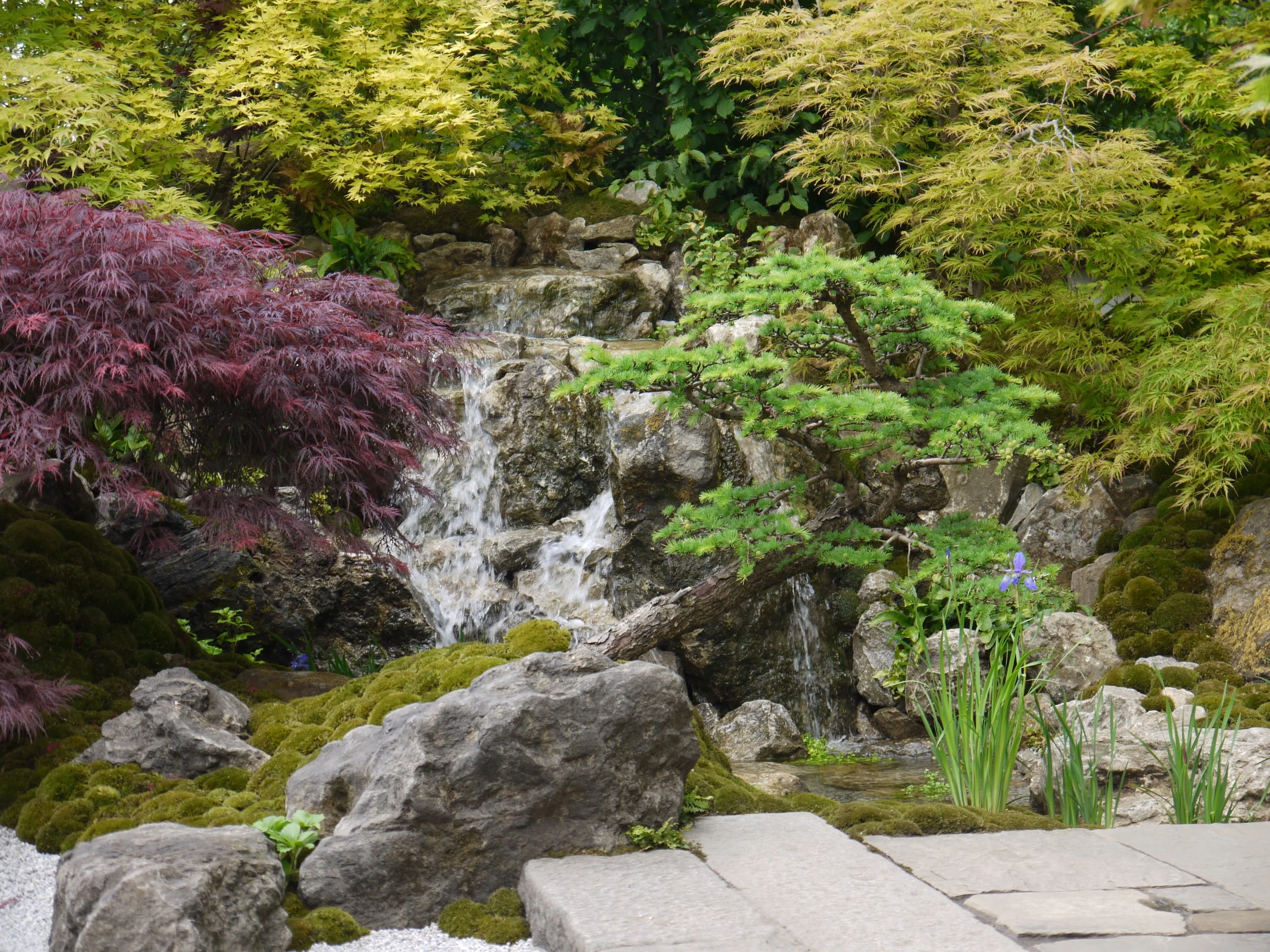
Photo Credit: Manoj Malde
A waterfall gushing of natural stone boulders, flowing into a gentle stream, surounded by Acers and sculpted pines evokes a feeling of being in the wilderness. However, this was created as a show garden at the RHS Chelsea Flower Show.
Stepping Into a Japanese Garden
Walking through a Japanese garden is unlike any other garden experience. There is a quality to these spaces that slows you down — not just physically, because the paths demand careful footfalls, but in some deeper way. The silence becomes all-encompassing. You find yourself treading gently, with a respect that seems to arise naturally from the space itself.
Japanese gardeners are highly skilled artists who pay attention to the smallest of details. The placement of every rock, the angle of every stone, the pattern raked into the gravel — all of it is considered. Nothing is left to chance.
These gardens began, as all gardens did, with the need to grow food. Over centuries they evolved into spaces of beauty and spiritual contemplation. And while in the western world that tradition gradually gave way to other garden styles, in Japan it has continued to live on — refined, deepened, and passed down through generations.
Today, Japanese garden design offers the rest of the world something we seem to need more than ever: a place to be still, to pay attention, and to remember that we are part of nature — not separate from it.
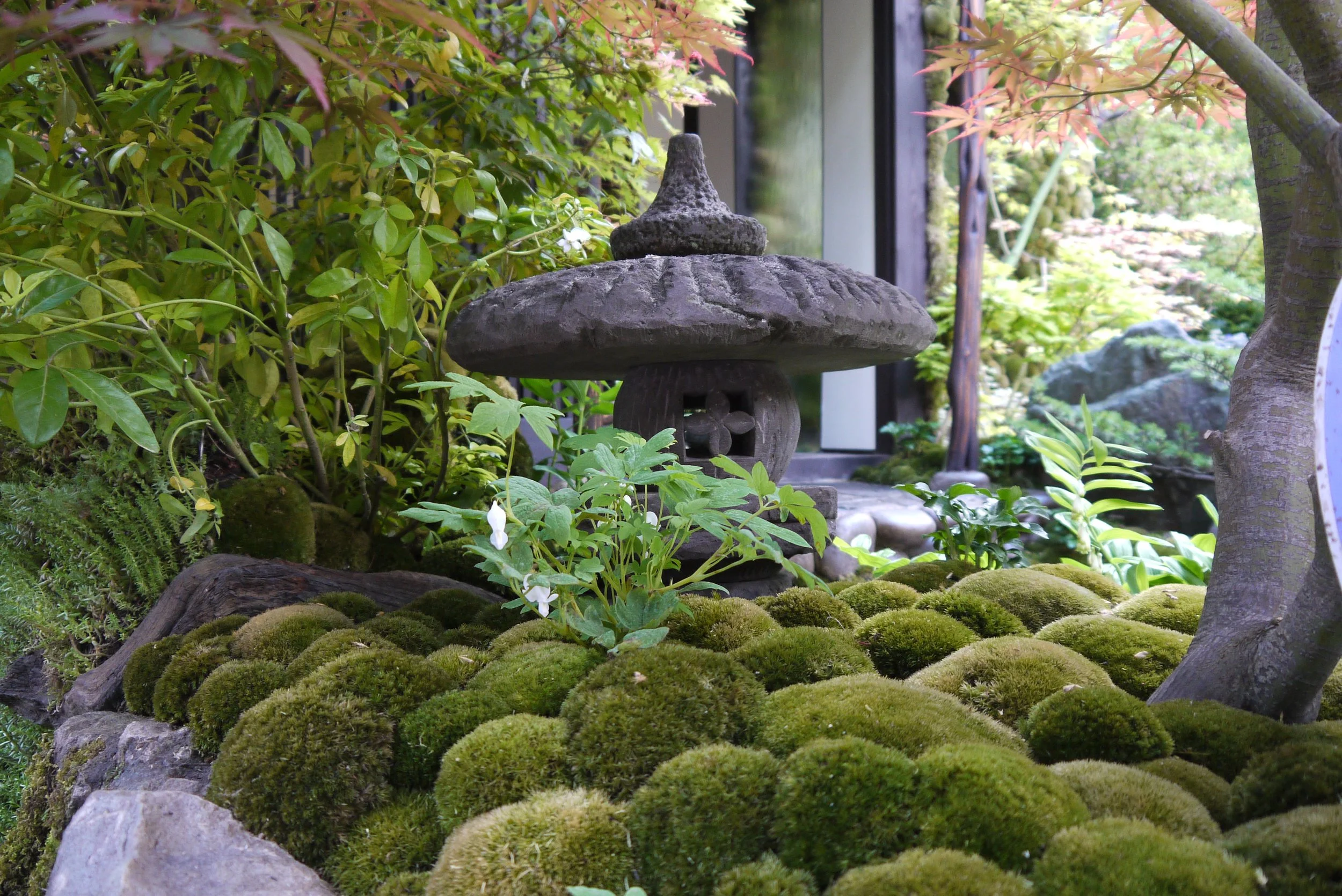
Photo Credit: Manoj Malde
Another small ishi toro discreetly placed along some stone steps but gently diguised by some planting. Japanese gardens are not about being showey. Less is more.
Thinking of creating a Japanese-inspired garden? Start with the philosophy, not the plants. Understand the principles of wabi-sabi, asymmetry and natural materials, and the rest will follow
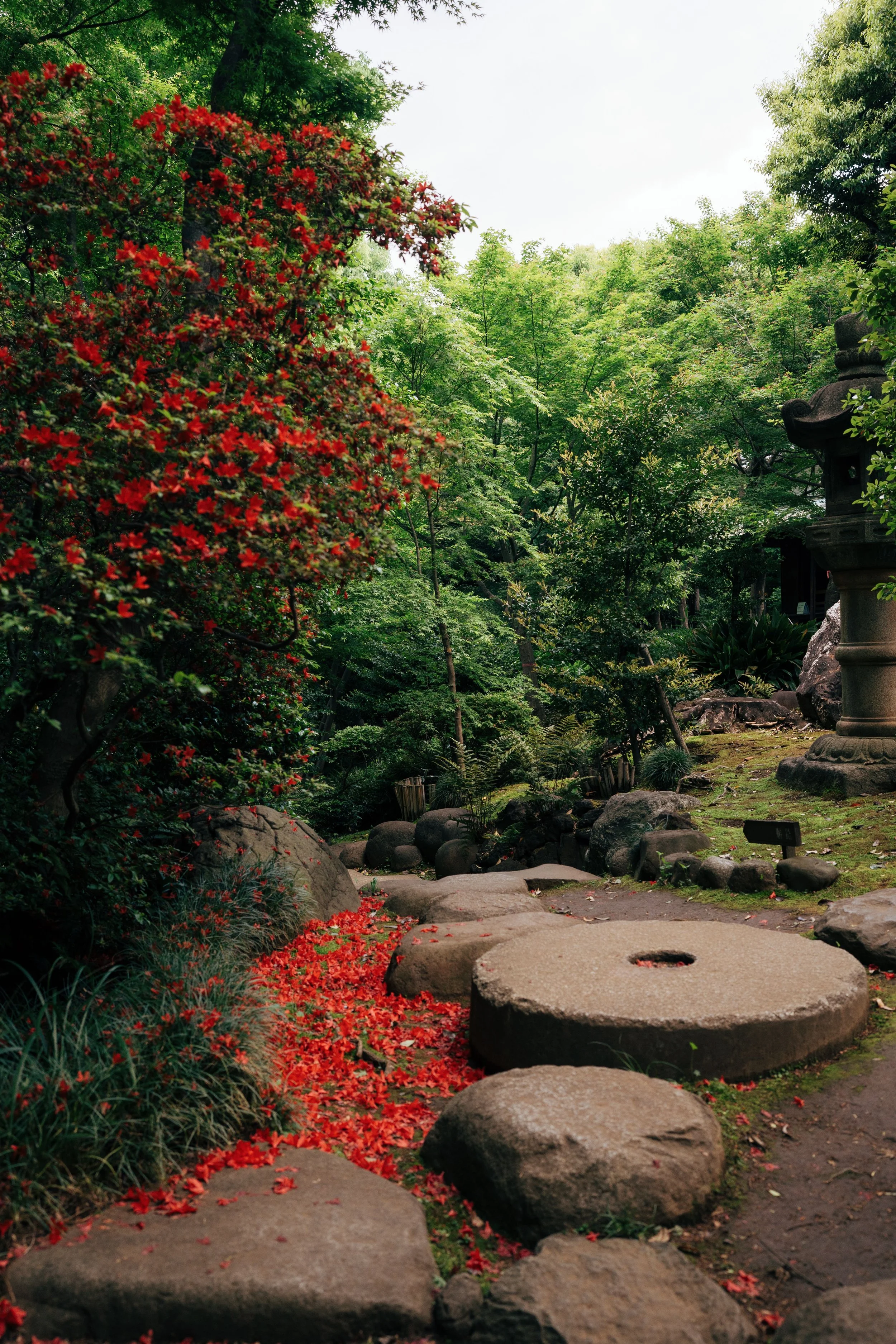
An old stone wheel looks like it has been repurposed as part of the paddle stone path, adding more character. Many rhododendrons and azaleas originate from Japan.