
MEDITERRANEAN GARDEN DESIGN
A Complete Guide to Creating an Authentic Mediterranean Outdoor Space
A Mediterranean garden is about far more than palm trees and terracotta pots. It's a way of living outdoors — shaped by sun, stone, and centuries of adapting to a hot, dry climate. But the Mediterranean basin itself is vast and varied: a garden in Provence looks nothing like one in Marrakech, and a courtyard in Andalusia has little in common with a terrace on the Amalfi Coast. Climate, terrain, local materials, artisan traditions and history all shape the result.
This guide covers the essentials of Mediterranean garden design — hardscaping, colour, water features and the best Mediterranean garden plants — so you can create a space that feels rooted in its landscape, wherever along the Mediterranean it sits.
What Defines a Mediterranean Garden?
What unites Mediterranean gardens across countries is a reliance on local, natural materials rather than anything manufactured, and a slower, simpler outdoor lifestyle built around shade, texture and the rhythm of the seasons. The look and feel changes from region to region, but the underlying logic is always the same: work with the climate and the land, not against it.
Drainage matters as much as drought tolerance. Even in naturally hot, dry climates, heavy autumn or winter rains can cause problems if the soil doesn't drain freely — plant roots sitting in waterlogged ground will struggle regardless of how much sun they get the rest of the year.
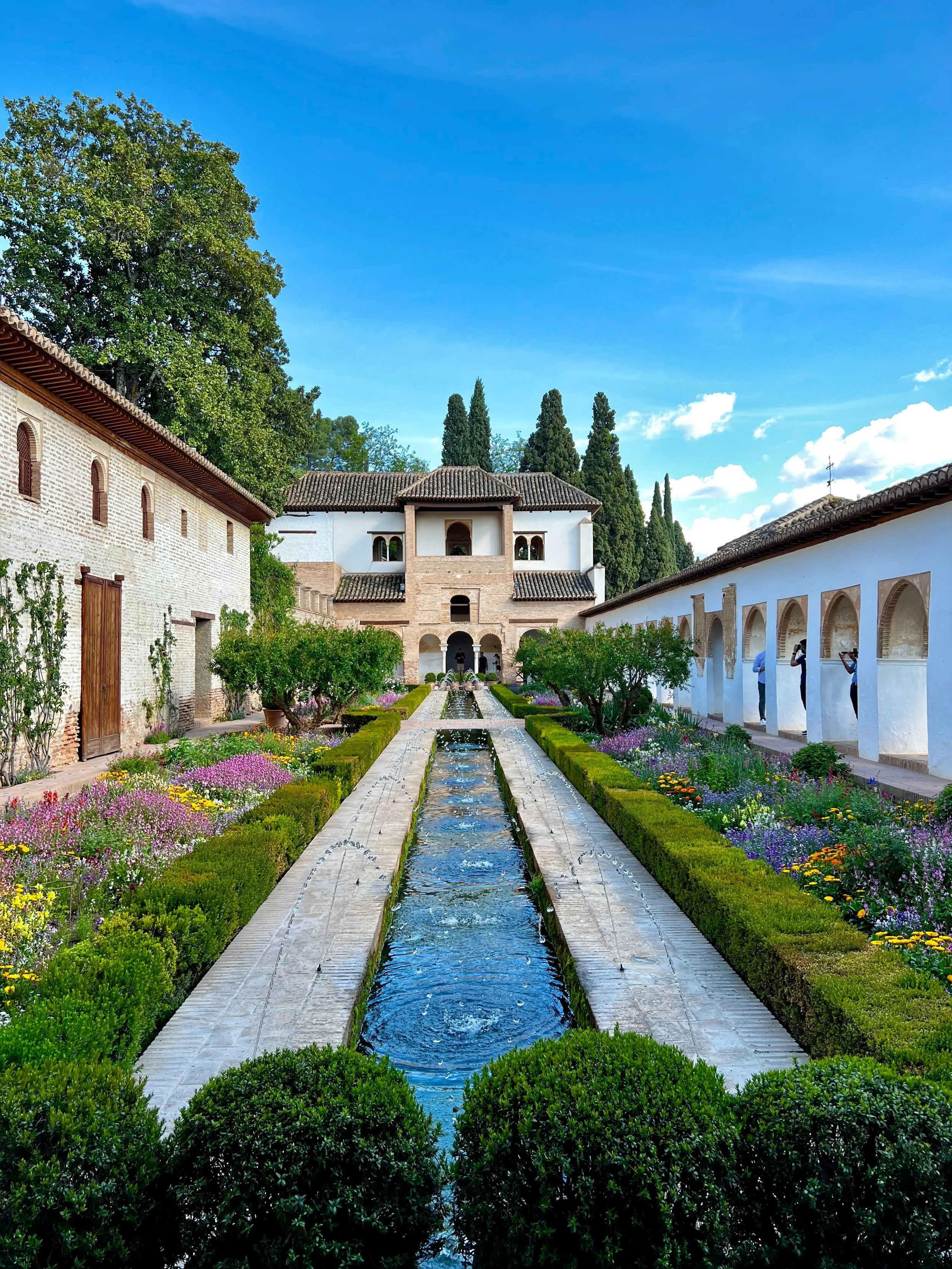
The gardens at the Alhambra have a distinct Moorish feel. Natural stone and clay bricks are used both in the architecture and hardscaping in the garden. The cloistered walkway provides a shaded area to walk under.
Hardscaping: The Foundation of Mediterranean Garden Design
Paving and Stone
Hardscape materials tend to be stone, gravel or concrete — earthy, tough and durable. Locally sourced stone gives a natural affinity with the surrounding landscape, which is why traditional Mediterranean gardens so rarely look out of place. Where natural stone isn't practical or affordable, granite setts, clay pavers, or porcelain paving that closely mimics natural stone are strong alternatives increasingly used across the region.
Pergolas and Shade Structures
No Mediterranean garden functions without serious shade. Pergolas are traditionally built from timber, though sun, coastal winds and salt spray dry out wood quickly, meaning regular staining or oiling is essential. For a striking, characterful look, consider:
Full tree-trunk posts, left to weather naturally over the years
Charred timber, which develops a protective, textured finish
Wood-effect, powder-coated aluminium or galvanised metal — low maintenance and easily softened with climbing plants
Beyond pergolas, shade sails, overhead rafters, slatted screens, or a veranda built into the property (shading the area below while creating a roof terrace above) are all worth considering — particularly in regions where summer temperatures regularly climb into the high 30s.
Outdoor Furniture
Timber furniture demands the same ongoing care as a timber pergola, which can be a burden in intense sun. Powder-coated aluminium or recyclable polypropylene furniture are practical, low-maintenance alternatives available in a wide range of colours. For something more characterful, a stone slab table set on a drystone base, or a live-edge wooden tabletop, makes a striking centrepiece for a courtyard or terrace.
Metal Accents
Metal is generally used sparingly — decorative cast iron railings, gates or grills being the most common application. Corten steel, with its rusted, earthy finish, blends beautifully into a Mediterranean landscape and works well for screens, wall cladding, water features and containers. One practical note: lay a gravel strip beneath any Corten feature, as the rust can stain surrounding paving over time.
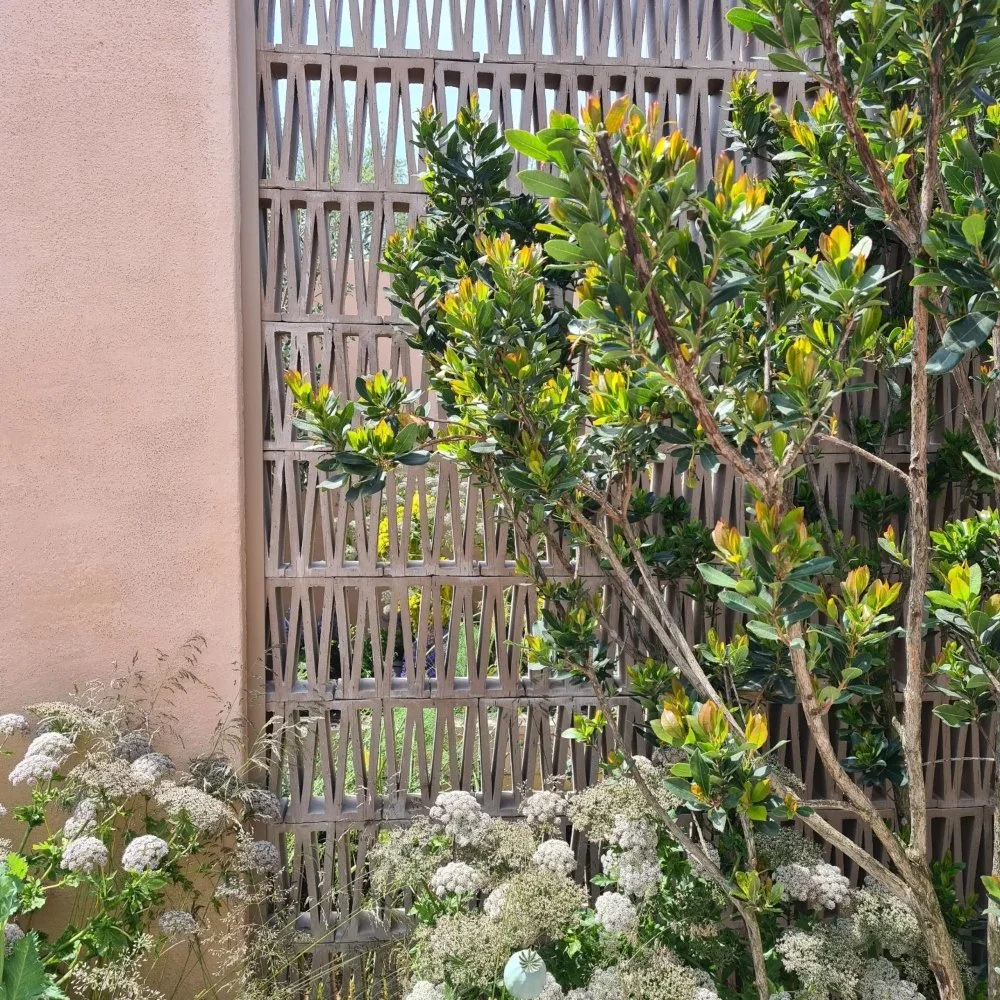
Photo Credit: Manoj Malde
The details in this Mediterranean garden are beautifully considered. The rendered wall has been painted clay pink to sit with the laticed clay brick. These bricks allow for privacy whilst letting the breeze through. The Arbutus unedo adds evergreen structure in the garden.
Colour in Mediterranean Garden Design
In places like Southern France, Italy, Spain and Greece the classic Mediterranean palette leans on sun-bleached, earthy tones — sand, stone, terracotta and white — reflecting the bleaching effect of intense sunlight on natural materials. But don't be afraid of bold colour. Destinations like Ibiza, Marbella and the Algarve regularly use vivid pink or orange rendered walls to dramatic effect, and the principle extends to similarly sun-drenched climates worldwide, from Mexico to Morocco.
The most celebrated example is Le Jardin Majorelle in Marrakech, where vivid cobalt-blue walls are paired with bursts of yellow planting. The lesson for garden design generally: use bold colour as an accent, not throughout the space. A single feature wall, or a vibrant backdrop behind a key planting display, has far more visual impact than colour applied everywhere. Coloured mosaic or zellige tiles — a hallmark of Moorish garden design across North Africa and southern Spain — offer another route into that vivid Mediterranean palette, alongside the more recent rise of beautifully patterned encaustic tiles.
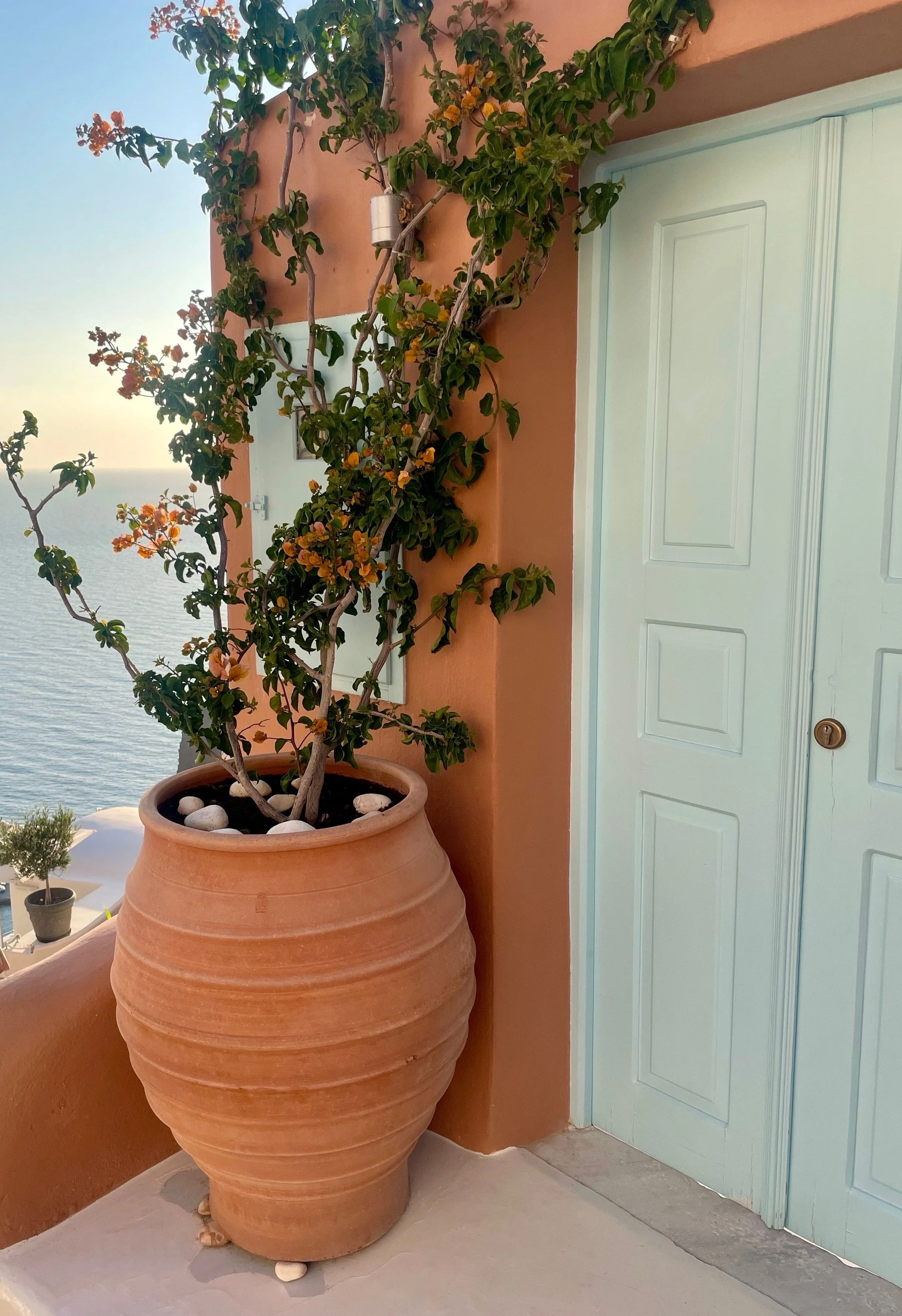
Terracotta and sunbleached, soft, powdery colours all work really well in Mediterranean gardens. If you use fresher hues of this colours rather than the greyed tone you will get a more modern look.
Lawns, Gravel and Ground Cover
Rethinking the Lawn
A traditional, lush green lawn sits awkwardly within true Mediterranean garden design — keeping grass green through a long, dry summer requires a volume of water that's increasingly hard to justify as water scarcity becomes a defining issue across the region. Where a lawn area is wanted, look to genuinely drought-tolerant grass varieties:
Kikuyu grass — a hardy, fast-spreading creeper that copes well with heat
Paspalum vaginatum — naturally found on salt marshes, making it ideal for coastal gardens exposed to sea spray
Zoysia grass — heat and drought tolerant, copes with some shade, has low water needs, and stands up to heavy foot traffic
Gravel Paths and Borders
Gravel is one of the defining features of Mediterranean garden design, and for good reason — it's inexpensive, locally available, and dramatically reduces water demand. It works beautifully for meandering pathways softened by planting at the edges, and as mulch within borders, where it suppresses weeds and locks moisture into the soil beneath. Choose a gravel colour and texture that suits the local stone and landscape, and keep the particle size to a maximum of 20mm so it remains comfortable to walk on. Gravel gardens are also remarkably low-maintenance once established — a significant advantage in a hot climate where garden upkeep competes with the heat of the day.
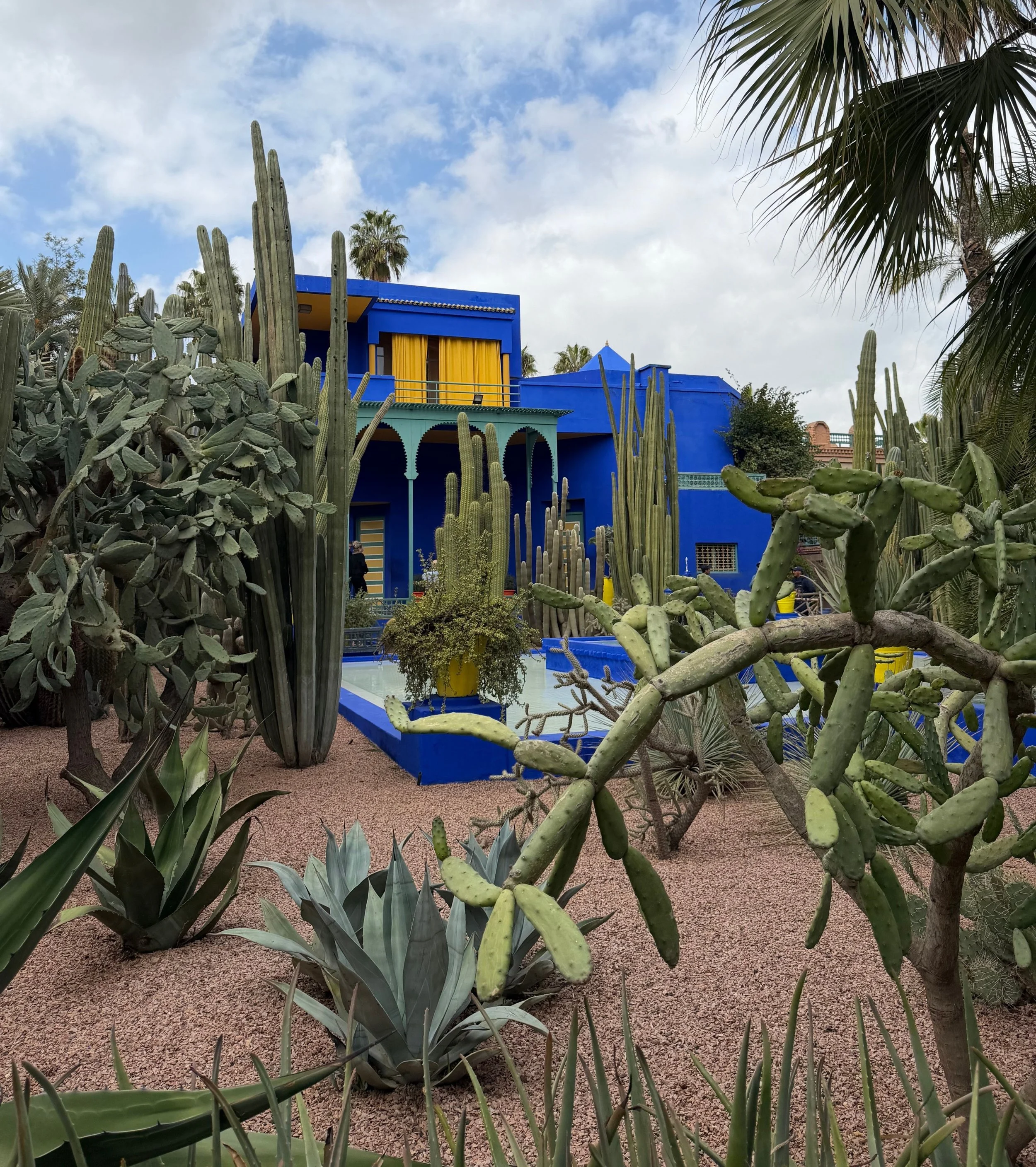
Whilst Mediterranean gardens often incorporate muted sun bleached colours, bold colours colours also work well as in this example of Le Jardin Marjorelle. Gravel is used as path and mulch. This can be sourced locally, it is cost effective, stops water evaporation and allows surface water to drain.
Courtyards, Terraces and Levels
Mediterranean gardens are rarely flat, particularly given how much of the coastline and hinterland across the region is hilly or mountainous. Expect different levels connected by stone retaining walls, steps, or winding paths — and sheltered courtyards enclosed by traditional stone walls, designed to provide a cool, private space for relaxing and entertaining away from the midday sun.
For walls, local stone is always the first choice. In places like Morocco, traditional skills such as rammed earth (hammered earth) construction and open fretwork screens using handmade clay tiles remain very much alive and worth seeking out. Where walls are rendered, there's no need to chase a perfectly smooth finish — a slightly rough, imperfect texture is true to the vernacular and adds real character. For steps, natural stone is the most authentic choice: flat stone slabs, stone-clad concrete, or stone-edged risers backfilled with gravel all work well. Soften the edges of steps and terraces with planting wherever possible, so the hard landscaping feels like it's grown into the site rather than been dropped onto it.
Where the underlying ground is largely bedrock — common across much of the Mediterranean — raised planting borders with stone retaining walls, backfilled with proper soil, are often the most practical solution.
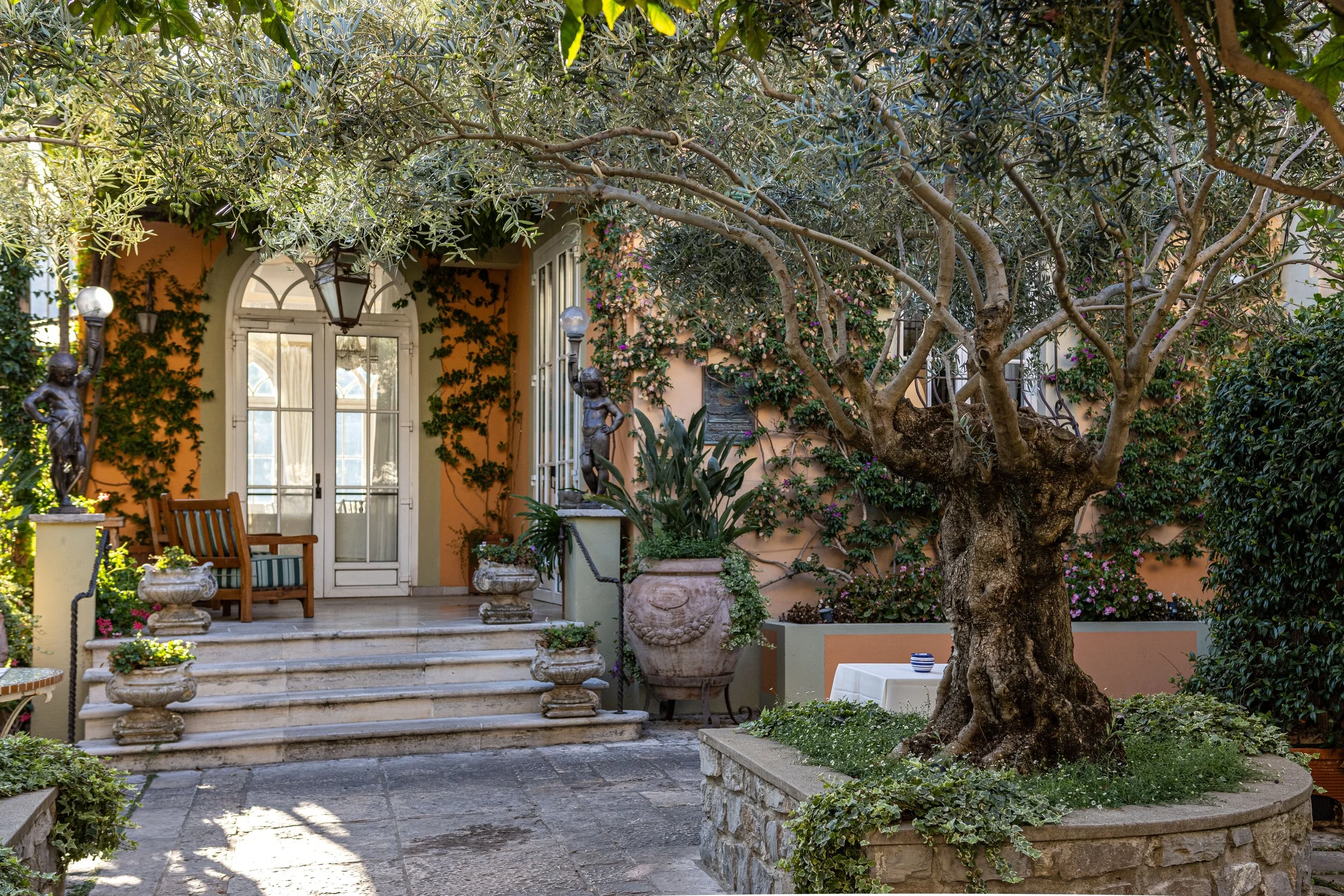
Old knarled olive trees are often associated with Mediterranean gardens. They are long lived and their spreading canopy provides shade. The grey green paint on the house picks up on the foliage of the olive tree, whilst the russet provides enhancing pop of colour.
Water Features for a Mediterranean Garden
Water in a Mediterranean garden exists to cool the air and provide a sense of calm, not to dominate the space. Think a simple pond, a small fountain, or a bubbling glazed pot rather than anything elaborate or water-hungry. The classic Moorish design, found across Andalusia, Córdoba and Morocco, uses a circular central feature with narrow rills extending outward — a layout that dates back centuries and was originally designed to irrigate as well as cool.
For many properties, the swimming pool effectively becomes the garden's main water feature, and the same principles of restraint and integration with the wider landscape apply. Whatever the scale, evaporation is a constant in a hot climate, so an automatic top-up system is worth the investment to avoid relying on a hose.
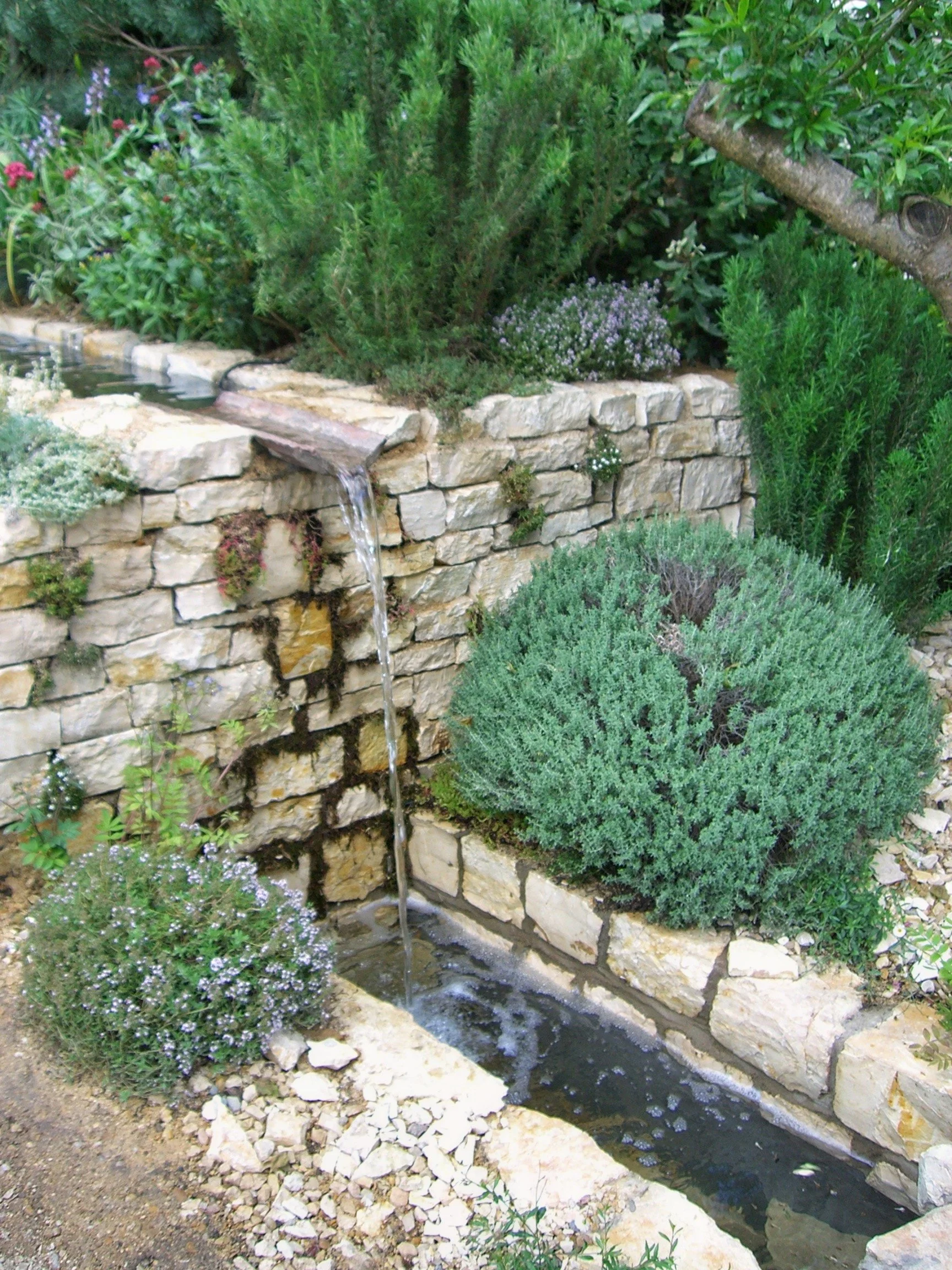
Photo Credit: Manoj Malde
The water feature makes a beautiful detail in this garden. The water upper stone wall trough flows into the lower one via an old clay roof tile. The plant used in the borders are thyme, rosemary and valerian.
Containers: Terracotta, Glazed Pots and Stone Troughs
Across the Mediterranean, traditional pottery skills remain very much alive, with terracotta the material of choice in Italy, Spain and Greece — each region developing its own distinctive glazes, shapes and finishing details passed down through generations of potters. Worth seeking out:
Glazed olive jars
Anduze planters, originally from Languedoc in southern France
Reclaimed stone water troughs, repurposed as planters with real age and character
Grouping terracotta pots of varying sizes — often filled with herbs, citrus or trailing pelargoniums — remains one of the simplest, most effective ways to bring instant character to a terrace, balcony or courtyard.
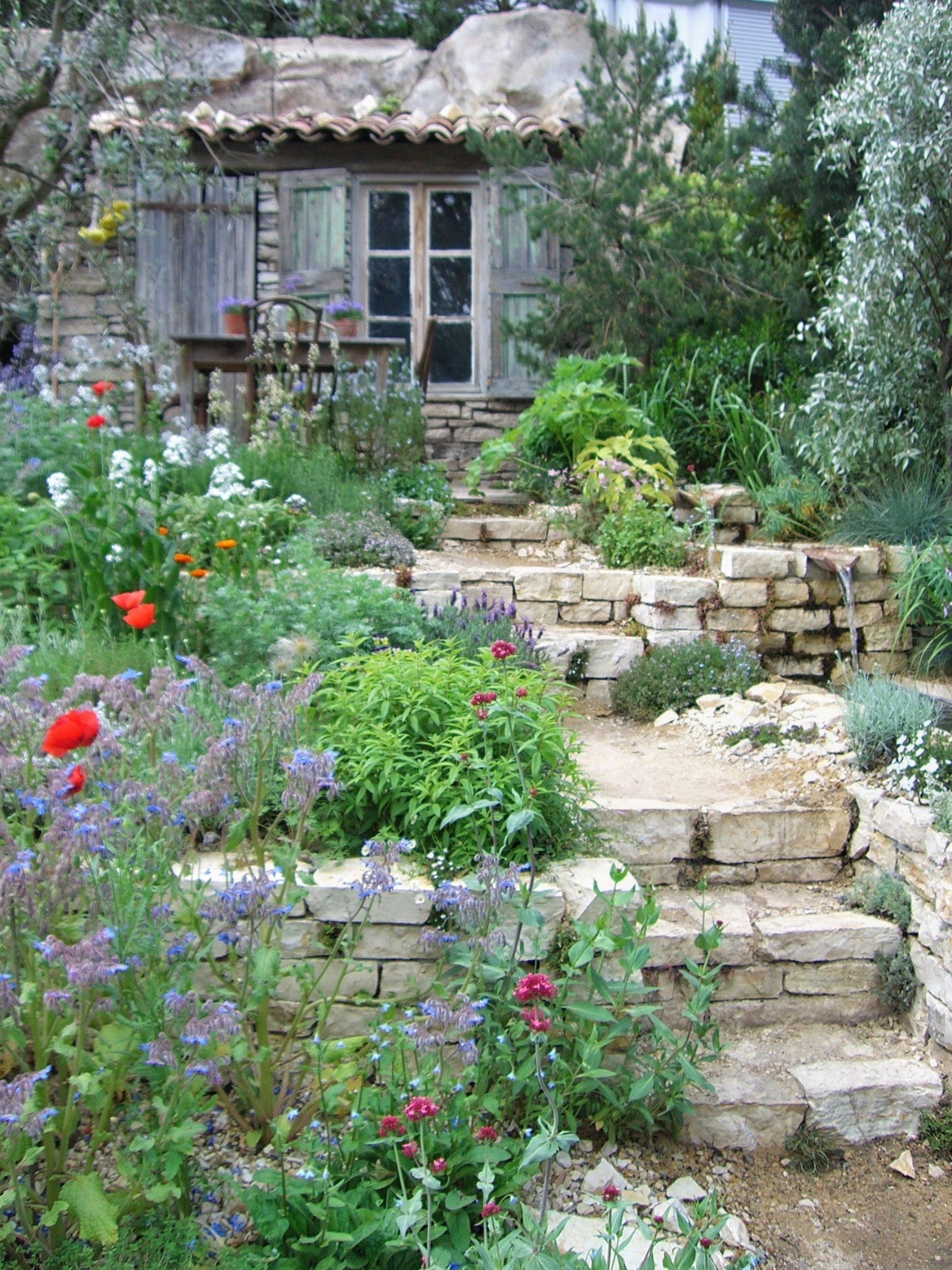
Photo Credit: Manoj Malde
Mediterranean gardens rely on natural local sourced materials to harness them into the environment they are set in. Here we see natural stone used for retaining walls and steps. Notice the detail of plants being allowed to grow naturally between the gaps in the stone.
The Best Mediterranean Garden Plants
Plant choice is what ultimately makes or breaks a Mediterranean garden. The defining trait of Mediterranean plants is drought tolerance — once established, their roots need to anchor deep and survive long dry spells largely unaided. Look for greyish or hairy leaves, small or waxy foliage, succulent water-storing tissue, and bottle-shaped trunks: all natural adaptations for minimising water loss under intense sun.
Below is a planting palette to draw from across the region. Always check that your chosen variety suits your specific microclimate, soil and aspect — coastal, inland and mountain conditions within the Mediterranean can vary enormously.
Trees: Olive, lemon, orange, pomegranate (Punica granatum), jacaranda, eucalyptus, mimosa, Italian cypress, stone pine (Pinus pinea), cycads, dragon tree, palms, holm oak, golden rain tree (Koelreuteria paniculata), frangipani, strawberry tree (Arbutus), Euphorbia candelabrum
Shrubs: Lavender, rosemary, lantana, oleander, euphorbia, Westringia, Teucrium, Dasylirion, Mexican salvias, Grevillea, Yucca rostrata, Phlomis, Pittosporum, myrtle, Helichrysum, Helianthemum, rock rose (Cistus)
Climbers: Jasmine, wisteria, climbing roses, evergreen jasmine, Campsis
Cacti & succulents: Aeoniums, agaves, barrel cactus, Bulbine, aloes, Euphorbia resinifera
Grasses: Pennisetum, Miscanthus, Stipa
Perennials: Bearded iris, salvias, Osteospermum, agapanthus, Tulbaghia, gaura, sunflowers (Helianthus), verbena, Mexican fleabane (Erigeron karvinskianus), Eryngium, Artemisia, Stachys, Chasmanthe
Annuals: Tithonia, Californian poppies, zinnia, gazania, Cosmos sulphureus, pelargoniums (geraniums), poppies (Papaver)
Bulbs: Alliums, cyclamen, species tulips, asphodel, scilla
Mexican fleabane deserves a special mention — it self-seeds readily into gravel, wall cracks and paving joints, creating that effortless, sun-baked look where plants appear to grow naturally from the stonework itself, a hallmark of older Mediterranean gardens that have settled into their setting over time.
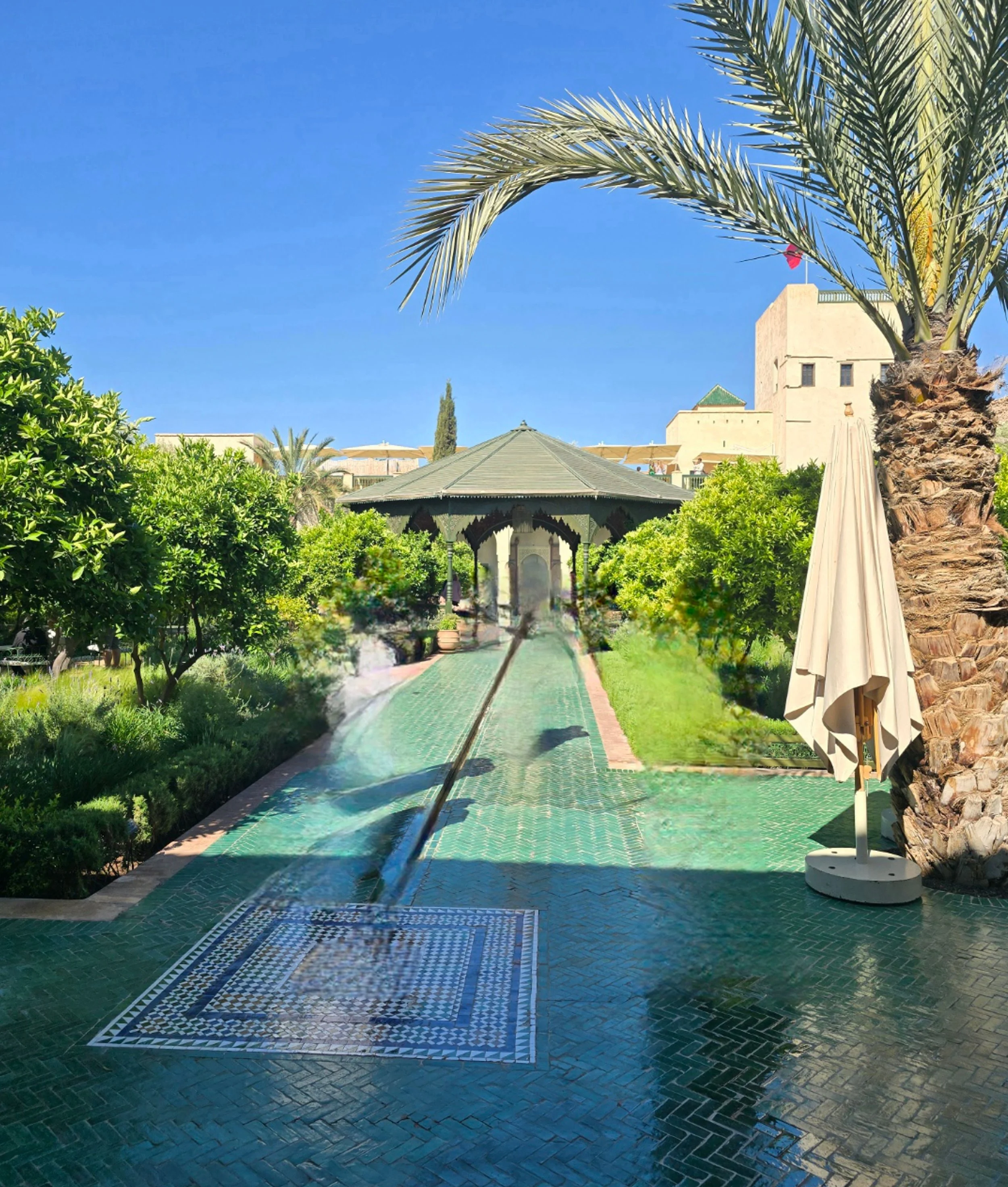
Designer: Tom Stuart Smith
Here in Le Jardin Secret paths are laid in zellige tiles is a classic herringbone pattern. The same can be done with clay pavers. Notice the central rill running through this garden in Marrakech.
Bringing It All Together
A successful Mediterranean garden isn't built by importing a generic style — it's built by paying close attention to what already works in the local landscape: the stone in the hillsides, the colours of the render on old buildings, the plants growing wild at the roadside, the way shade falls across a courtyard at midday. Get the drainage and material choices right, lean into drought-tolerant planting, and let local craft traditions inform the details, and the result will feel less like a constructed garden and more like a natural extension of the place itself.
Whether the setting is a hillside terrace in Tuscany, a walled courtyard in Marrakech, or a coastal plot on the Costa del Sol, the same underlying principles — sun, shade, stone and restraint — will always produce a garden that belongs exactly where it stands.
Looking for help designing your own Mediterranean garden? Get in touch to discuss a planting plan and hardscaping design tailored to your site, climate and local materials.
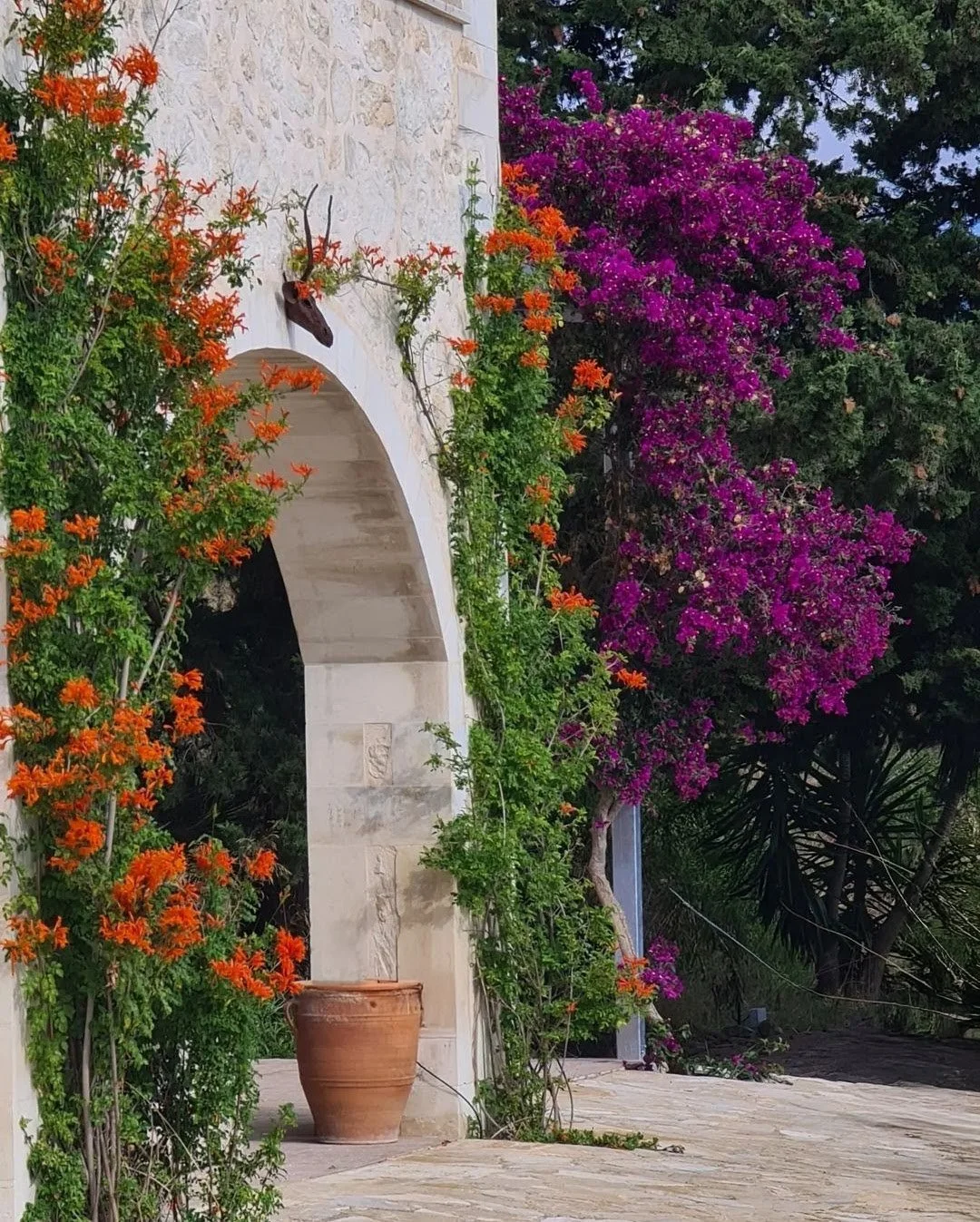
Designer: Manoj Malde
In Mediterranean gardens you often see the house wall or pergolas covered in climbers or tumbling down balconies. Some climbers to consider in a Mediterranean garden are Bouganvillea, Campsis, Jasmine and Tecoma capensis.