
SUSTAINABLE GARDEN DESIGN & GARDENING
INTRODUCTION
When we hear the word sustainability, it can sometimes feel like one of the words that has been overused and we almost stop hearing it.
Sustainable design. Sustainable landscaping. Sustainable gardening.
But what does sustainability actually mean when we are designing and building gardens?
For me, it is quite simple
Sustainability is about creating gardens that can thrive for the long term, while using fewer resources, creating less waste and working with nature rather than constantly fighting against it.
This is becoming increasingly important as the climate that we garden in, is changing. We are experiencing hotter, drier summers, periods of drought, intense rainfall, unpredictable weather and more extreme temperature fluctuations.
This is becoming increasingly important as the climate that we garden in, is changing. We are experiencing hotter, drier summers, periods of drought, intense rainfall, unpredictable weather and more extreme temperature fluctuations.
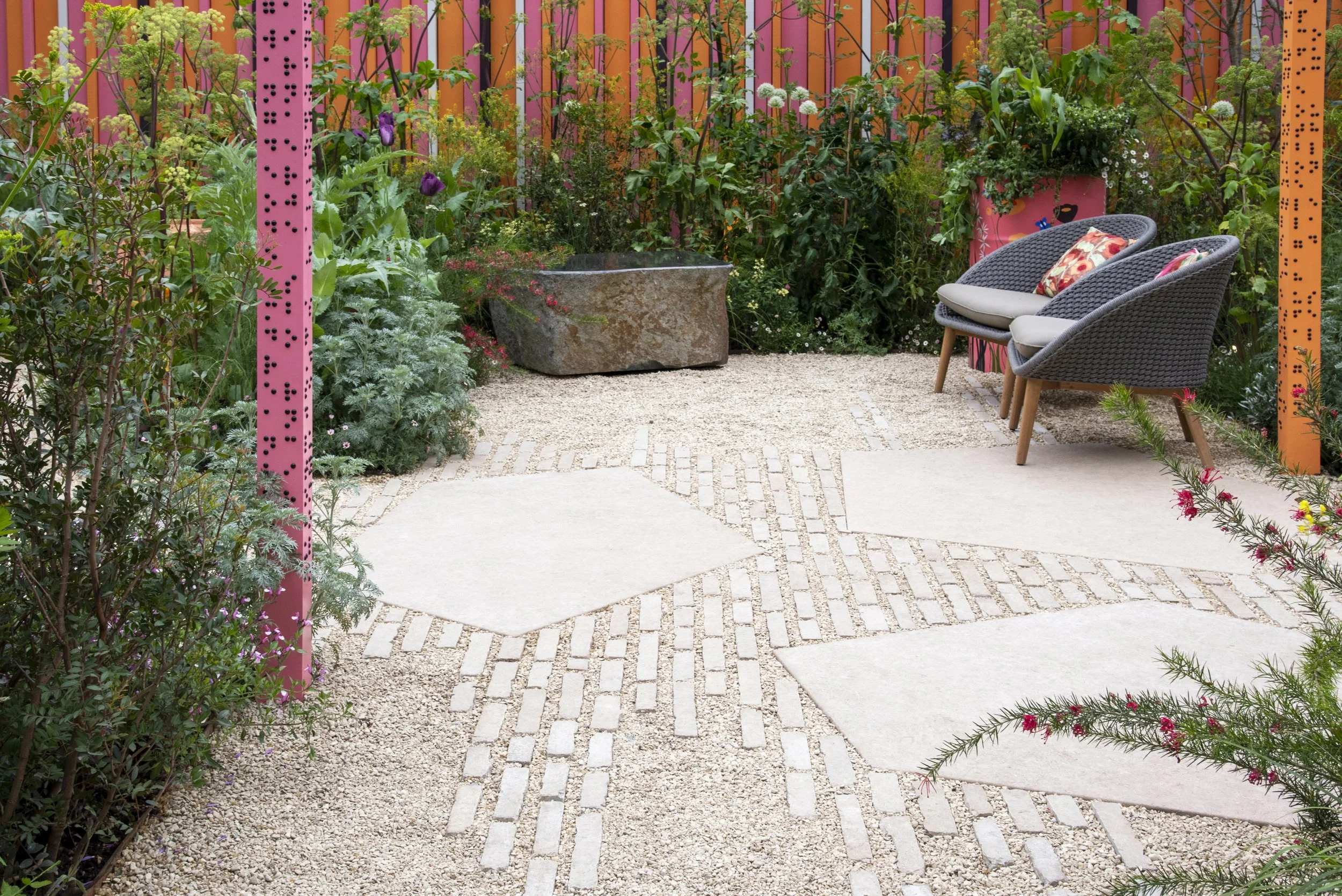
Designer Credit: Manoj Malde Photo Credit: Lynne Taylor
In this garden I decided that all the waste from the large slabs that were cut for us should be used as small setts. Doing this created zero waste from the limestone. The garden continues to live on at a childern’s school in Battersea, South London. The wonderful thing about natural stone is that it can continued to be reused and repurposed at the end of it’s current life.
START WITH THE SITE
Sustainable garden design starts with understanding your site, before you select your first plant.
What is the soil like?
Where does the sun fall?
Where are the shaded areas?
How does water move through the garden?
Is the soil free-draining or heavy?
What existing trees and plants are already there?
More importantly:
What can we keep?
One of the most sustainable approaches to garden design and gardening is to avoid removing things unnecessarily.
An existing mature tree is not just a tree. It has taken decades to grow. It adds instant maturity and history to the garden. Replacing it with another mature tree is an unnecessary expense.
A mature tree stores carbon, provides shade, supports wildlife, contributes to the character of the garden and helps to moderate temperatures. Replacing it with a new tree might eventually achieve some of those things but it does not replace what we have lost.
So before we reach for the chainsaw or excavator, we should ask ourselves:
Can we design around what is already there?
The most sustainable approach to design is not to destroy what is already working.
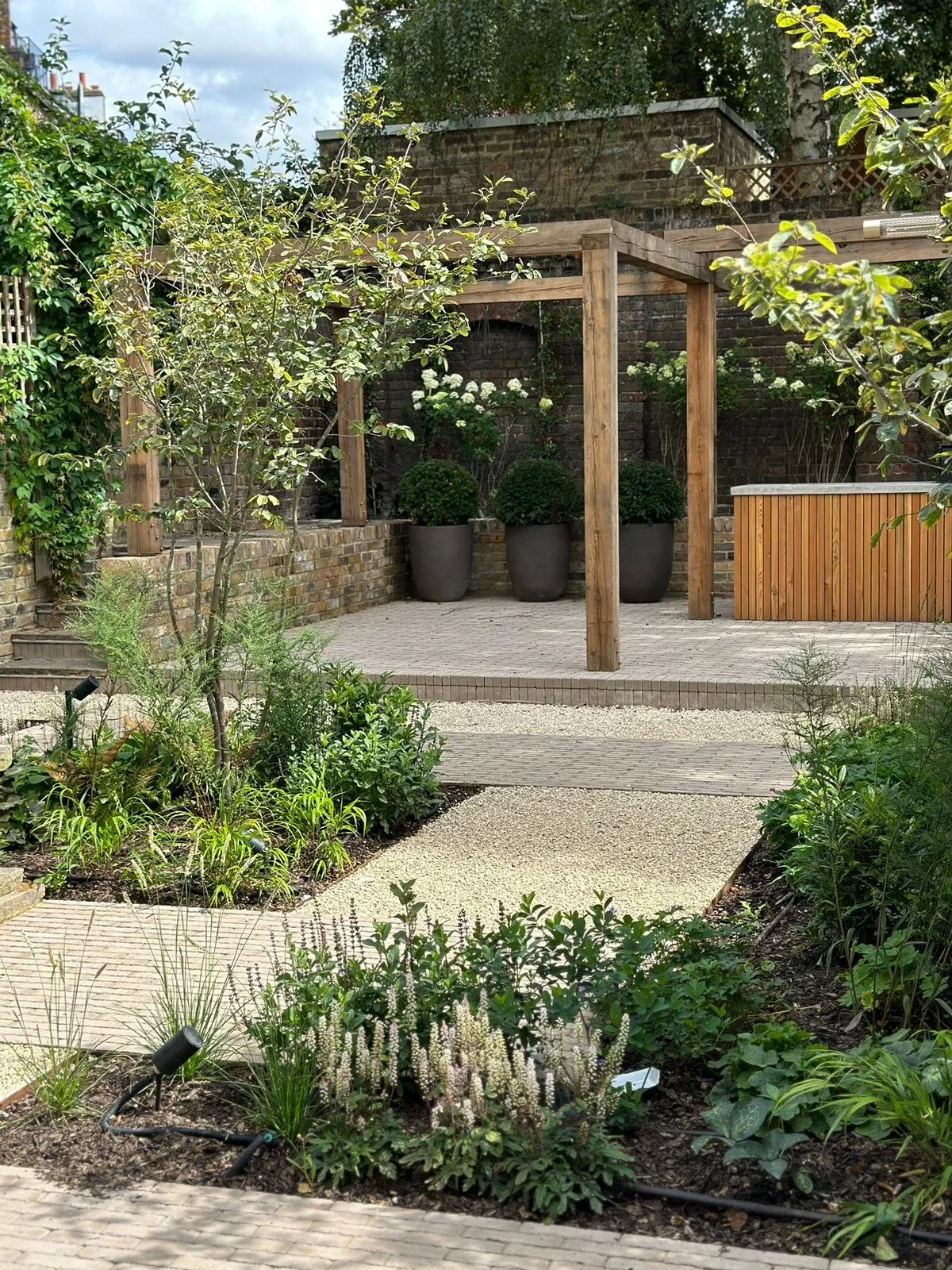
Design Credit: Manoj Malde
In this garden in Highbury & Islington, we had saved all the bricks from an old wall. These were then cleaned up and reused in the construction of the new walls.
SOIL IS THE FOUNDATION
We also need to think much more carefully about our soil. Everything starts from the soil.
Soil is full of life. It contains extraordinary ecosystem organisms, fungi, bacteria and invertebrates. Rather than treating soil like a building material, digging it up and moving it around or replacing it, soil should be protected and avoid unnecessary disturbance. Use compost and organic matter appropriately. Cover soil with mulch. This will reduce evaporation and feed your soil. Avoid compaction of your soil.
Healthy soil is fundamental to healthy plants.
And healthy plants are generally more resilient to drought, pests and disease.
So, sustainability begins underground.
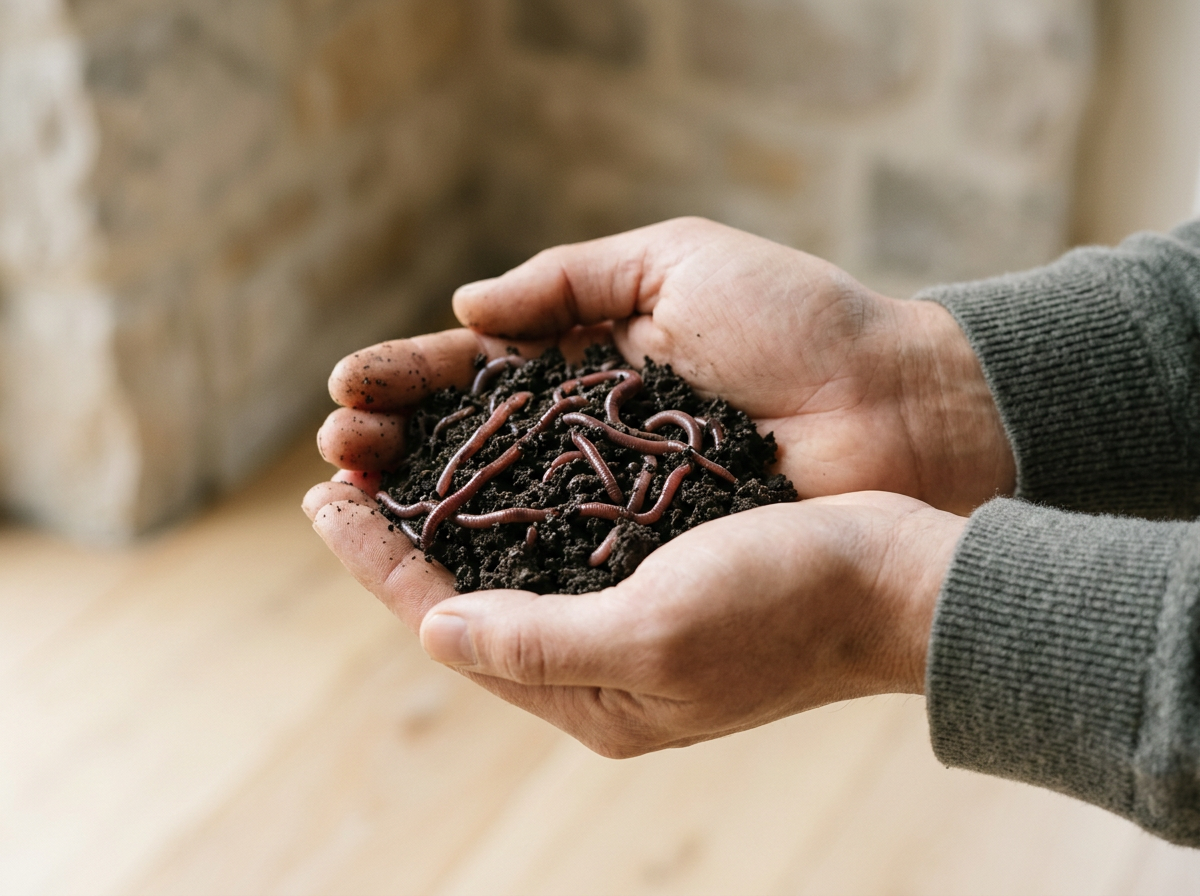
Healthy soil is fundamental to healthy plants and gardens that can cope with the changing climate. Healthy soil means less use of artificial fertilisers. This means a cost savings and less plastic packaging going to landfill.
WATER
Water is becoming one of the biggest issues facing gardening. For years, we have just assumed water will be available. Should we be planting thirsty plants and designing irrigation systems to water them?
Or should we be asking:
Can we choose plants that are naturally suited to the conditions?
Think about plants that come from hot, dry climates.
Plants with silver or grey foliage.
Plants with aromatic leaves.
Plants with small leaves.
Plants with furry velvety leaves or waxy leaves.
Plants that naturally cope with periods of drought.
The Beth Chatto Gravel Garden is a very good example of this principle, demonstrating that with the right plants, the right soil and the right conditions, a garden can be beautiful without relying on constant watering.
That doesn’t mean every garden needs to be a gravel garden. But it does mean we should understand the principle of Right Plant, Right Place. This is one of the oldest principles of good gardening and one of the most sustainable.
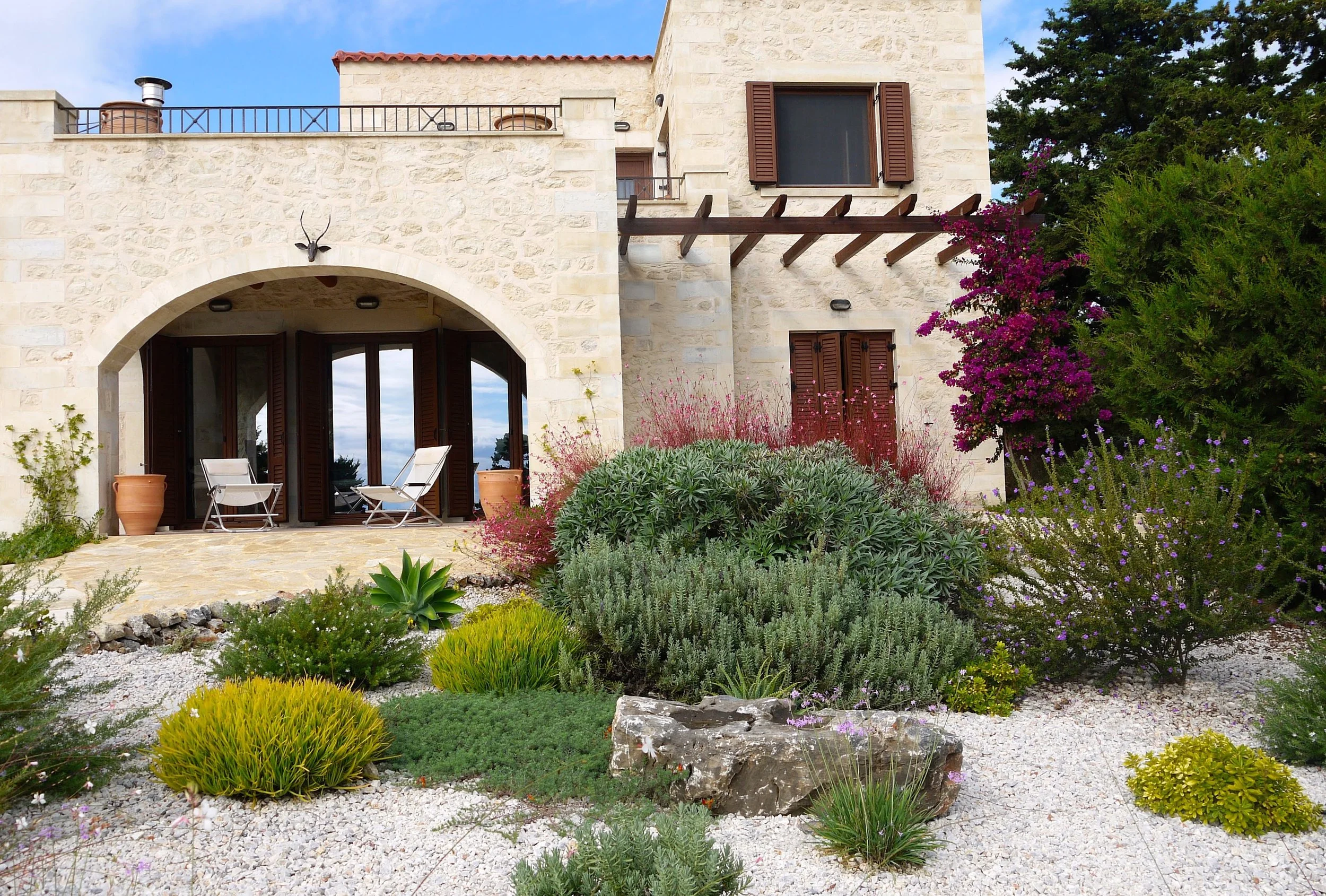
Design & Photo Credit: Manoj Malde
As our winters get wetter and summers get drier, it is important to grow plants, trees and shrubs that are going to be resilient to the climate changes of the future. Take inspiration from Mediterranean gardens. Plants with silvery leaves, small leaves, hairy or waxy leaves suffer less from water evaporation. In the UK the biggest killer of plants is winter wet. This why it is important to understand the conditions and health of your soil.
THE LAWN QUESTION
I am certainly not anti-lawn. Lawns can be incredibly useful. They provide a space for the children to play, somewhere to sit, a visual within a planting scheme and a habitat when managed appropriately. However, do we really need enormous areas of perfectly green grass that require a lot of water to keep them looking beautiful, particularly during periods of drought?
Maybe we need to rethink what lawns are supposed to do.
Could we reduce the size of the lawn?
Could we allow it to grow slightly longer?
Could we introduce more resilient grass species?
Could areas become meadow?
Could some parts become planting?
Sustainability doesn’t necessarily mean removing the lawn. It means asking whether the lawn is performing a useful function and whether we are managing it properly.
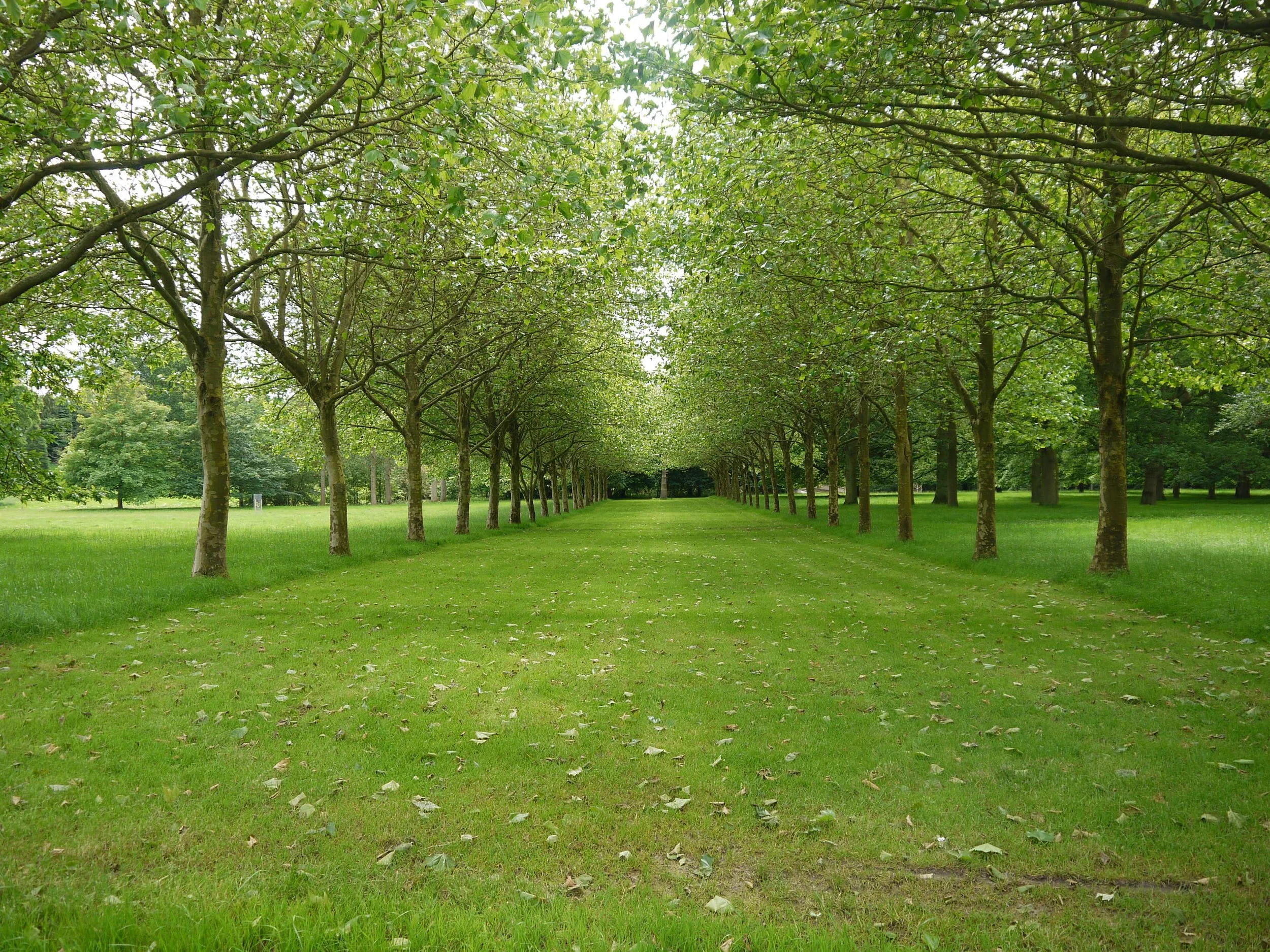
Lawns look wonderful when perfectly green but they are high maintenance. As our climate changes, water consumption is very high to keep them green. This does not seem sustainable when water resources are low in summer and the price of water increases. Would it not be better to reduce the size of our lawns, use more drought tolerant grass species or plant areas as meadow.
BIODIVERSITY
A sustainable garden should ideally work for needs of the owner but also provide opportunities for wildlife.
Birds, bees, butterflies, hoverflies, ladybirds, beetles, frogs, toads, newts, hedgehogs and countless other organisms that we may never notice.
This doesn’t mean that every garden needs to become wild. It just mean we need to think about how we design and garden to make our gardens incredibly valuable habitat.
How do we help create more biodiversity in the garden?
Grow a diverse range of plants.
Grow plants of varying heights.
Make sure there are different flowering periods through the planting scheme.
Plant trees, shrubs, herbaceous perennials, climbers, grasses, ground cover, plants with seed heads and berries.
Plant hedges.
Water is very important. Every living thing needs water.
Dead wood and piles of leaves.
Most importantly, create places where insects and other creatures can shelter.
Biodiversity is not something that happens somewhere else. Our gardens are part of the wider landscape. Every garden is another piece of the ecological jigsaw.
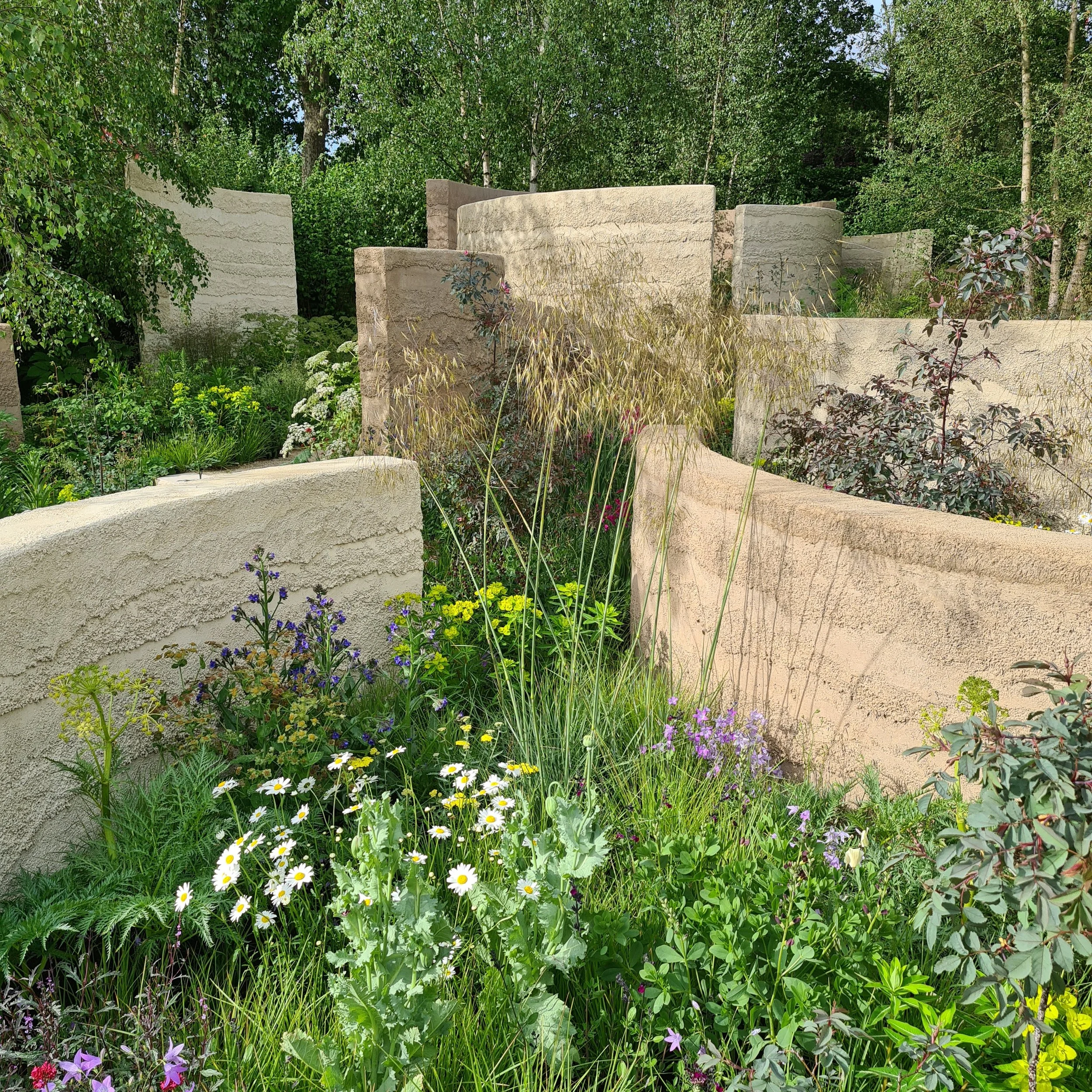
Design Credit: Andy Sturgeon Photo Credit: Manoj Malde
Increasing the variety of plants, trees and shrubs will help increase the biodiversity in the garden. Not only will this help provide food for wildlife but it will also help create habitat and shelter.
MAINTENANCE IS PART OF SUSTAINABILITY
A part that is often overlooked in a garden is the maintenance.
A garden A garden can be beautifully designed and environmentally conscious—but if it requires enormous amounts of watering, feeding, mowing, pruning and chemical intervention, is it really sustainable?
A sustainable garden should be designed with its future maintenance in mind.
Who is going to look after it?
How much time do they have?
What equipment will be required?
How much water will it need?
How much green waste will it produce?
It is better to design something that becomes better as it matures and needs less control. From a design perspective, a gardens life only begins when we hand it over to the clients
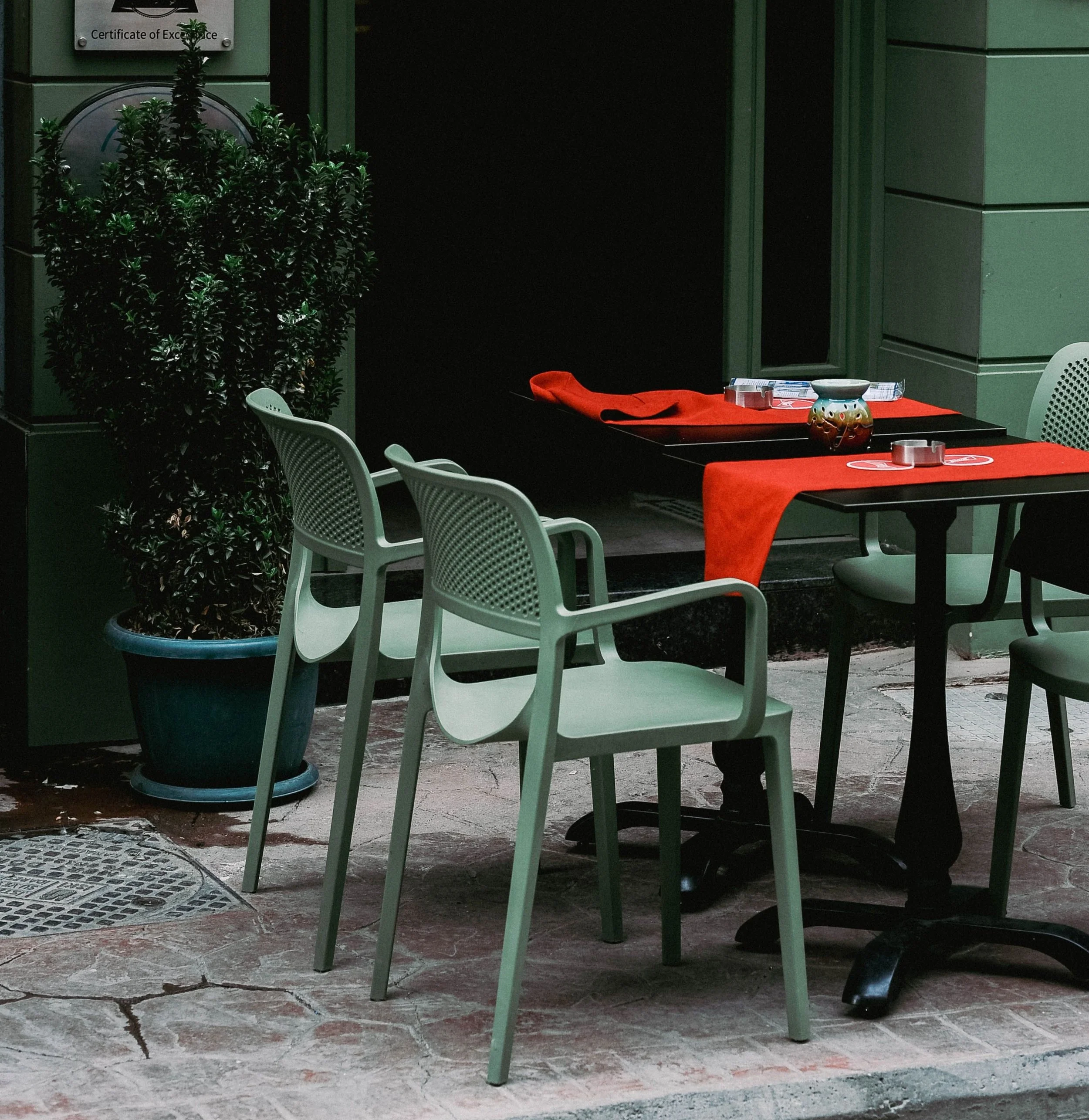
Think about the materials used in the garden. Polypropylene garden furniture can be recycled at the end of it’s life whilst plastic furniture cannot. Aluminium has a far higher carbon footprint than steel.
THE ROLE OF DESIGNER & LANDSCAPER
Garden designers, landscapers, contractors, nurseries and gardeners all influence the decisions that are made. It is the industry’s opportunity to educate the public. Understand the client’s needs and requirements and then:
Find better solutions.
Look at more resilient planting.
Look at reusing and repurposing some of the existing materials.
Reduce the amount of hardscaping in the garden.
Introduce harvesting rainwater.
Can existing trees be retained?
Can the soil be improved?
Can habitat be created for wildlife?
Can the garden be made easier to maintain?
Most importantly, can we do all of this without compromising beauty?
Because sustainable gardens do not need to be ugly.
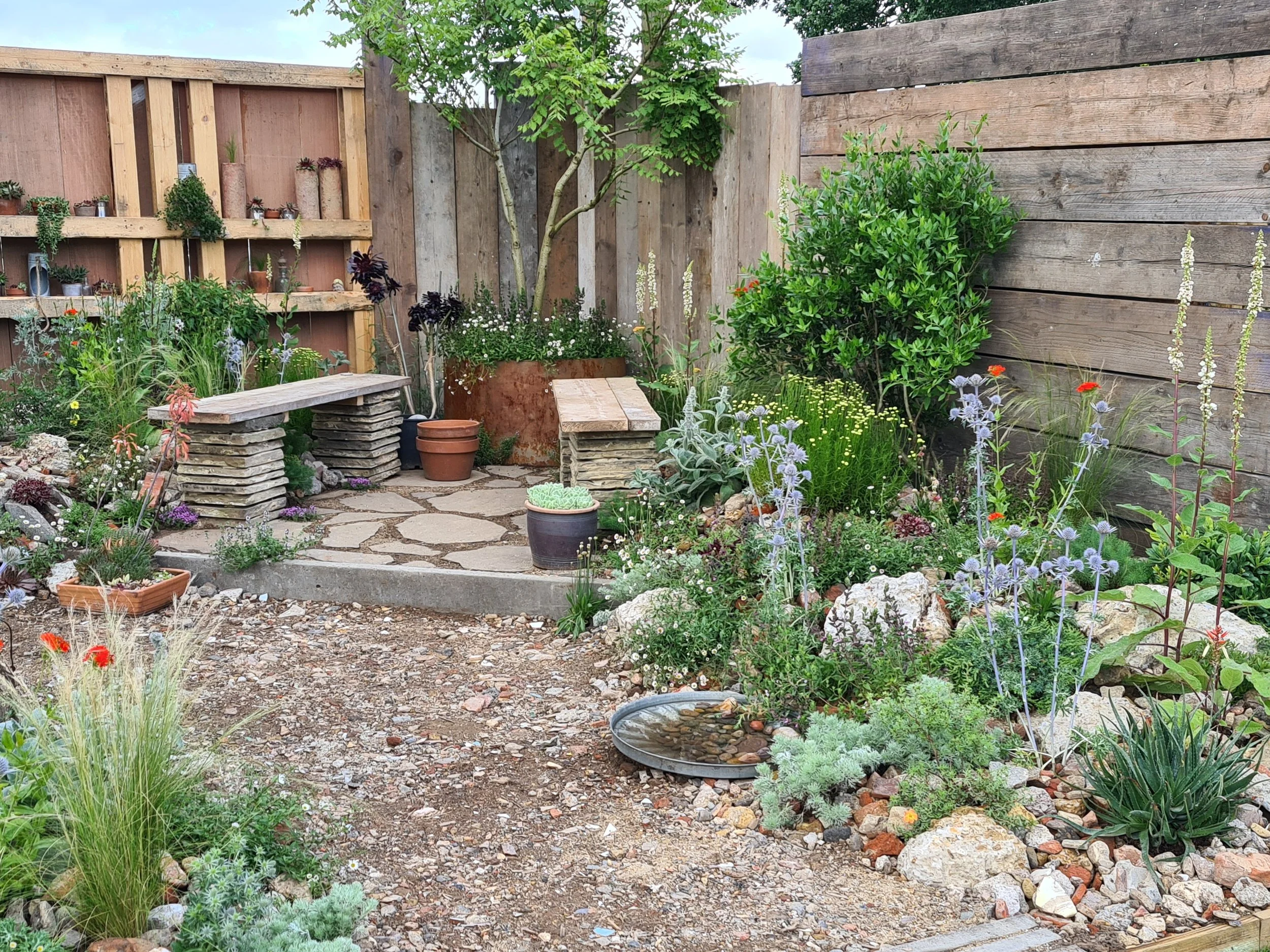
Photo Credit: Manoj Malde
This garden is a beautiful example of a sustainable garden. All the materials have been recycled and repurposed. Paving slabs have been built up to create the bases of the benches. Hardscape materials have been crushed to be reused both as planting mulch and for pathways. The dustbin lid turned upside down provides wildlife with a space for water.
SUSTAINABILITY IS ABOUT DOING THINGS DIFFERENTLY
Gardens are not about perfection. Nobody is going to be able to create a 100% sustainable garden.
Every material has an impact.
Every plant has a story.
Every construction project has transportation, machinery, labour and resources involved.
What we can do is make better decisions.
We can ask better questions to ourselves and our suppliers.
We can reduce unnecessary waste.
We can reuse what we have.
We can choose resilient plants.
We can protect soil.
We can manage water intelligently.
We can encourage biodiversity.
We can build things to last longer.
Most importantly, we can create gardens that are appropriate to their place, that actually function sustainably.
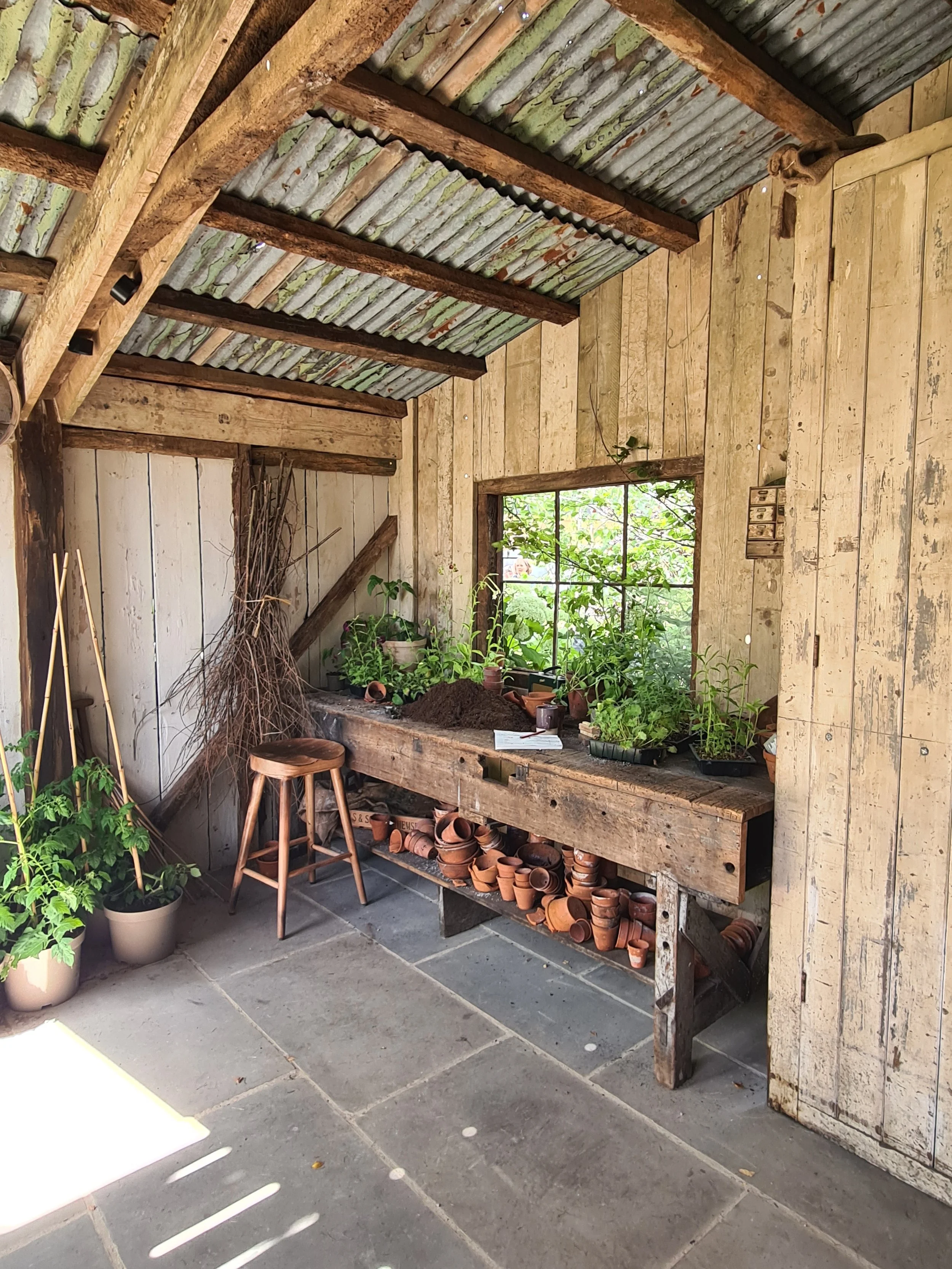
Photo Credit: Manoj Malde
Timber is a sustainable material but make sure any timber that you buy has the FSC (Forest Stewardship Council) logo on them. This means the timber comes from managed forests. An alternative is to buy timber from salvage yards like Ashwells Reclaimed Timber Ltd
Gardens that cope with the changing climate, support wildlife and use resources responsibly. Gardens that become more beautiful as they mature. Gardens that can still be enjoyed by the people who inherit them.
A simple way to look at a sustainable garden is:
Less water
Less waste
Less unnecessary construction
Less chemical intervention
Less disturbance
And instead:
More biodiversity
More resilience
More life
More longevity
Sustainability should be part of the natural thinking process from the very beginning.
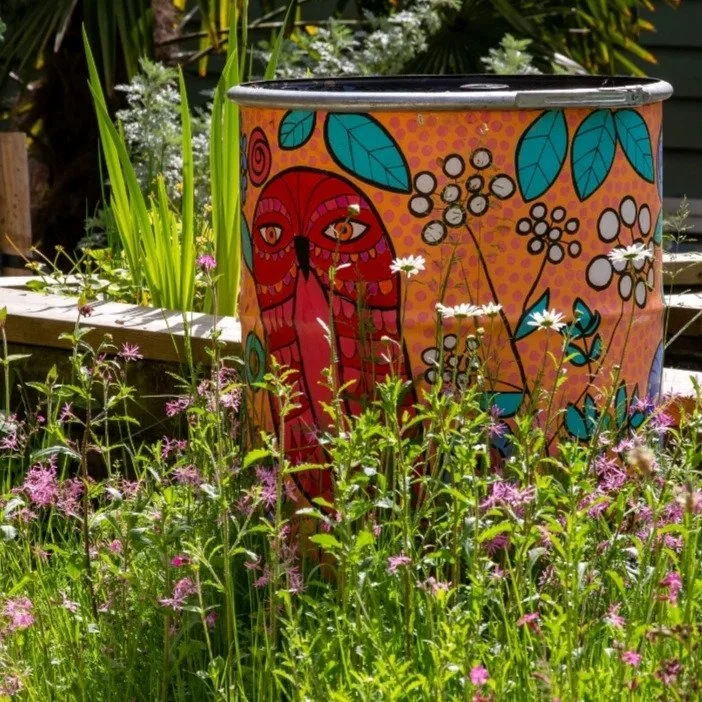
Design Credit: Manoj Malde Photo Credit: Stephen Studd
Think of innovative ways of using things. Here an old oil drum has been cleaned, painted and given a new lease of life. The drum can be used a s planting container. If you place a flat circular top on it, it can be used as a table.
Main Image Designer Credit: Sophie Godber Photo Credit: Manoj Malde